
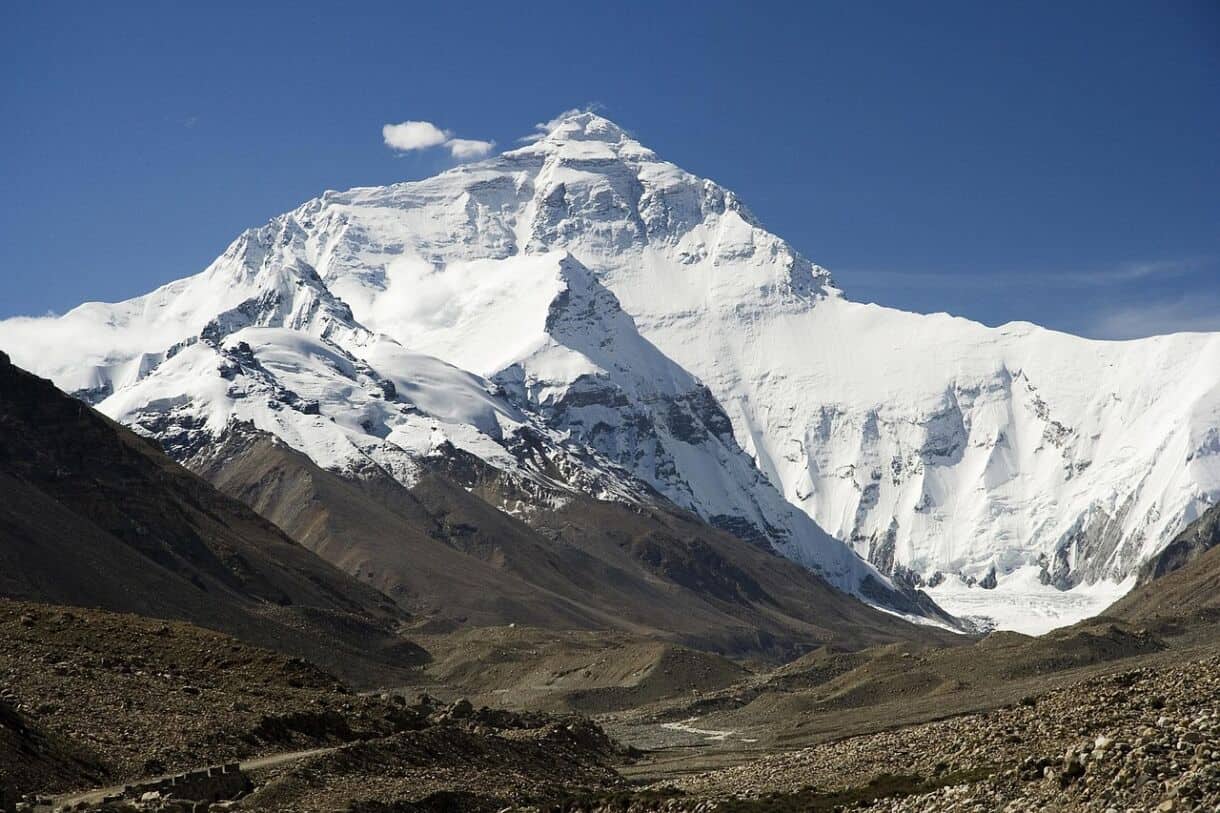
Mount Everest Is Getting Taller Every Year
By: Sarah Stone
Skip to Section
Mount Everest already holds the title of tallest mountain on Earth, depending on how you measure it. It sits at just under 8,850 meters, and it is not done growing. Every year, the mountain gains a few more millimeters of height.
How Everest Grew From the Bottom of the Ocean up to the Sky

To understand why Everest keeps growing, you have to go back millions of years, to a time when the rock now sitting at the summit was actually part of the ocean floor.
When the supercontinent Pangea broke apart, its pieces drifted across the planet, bumping into one another and building up new land. Over time, this formed the separate continents we know today.
Around 45 million years ago, one of those pieces, the Indian subcontinent, drifted north and slammed into the Eurasian plate. Instead of stopping, India started sliding underneath. That crushing, grinding pressure forced ancient limestone from the old seafloor upward into the sky. Over millions of years, that upward shove created the Himalayas.
The Collision Hasn’t Stopped
The Indian plate has continued pushing into Asia, with constant pressure lifting Everest and its neighboring peaks a little higher all the time. For Everest specifically, that amounts to roughly 2 to 4 millimeters per year.
That number sounds tiny, and on a human timescale, it is – but geology doesn’t run on human time. Stretch that growth across a million years, and Everest could stand more than a mile taller than it does today. The mountain already reaches about 5.5 miles high, so tacking on another mile and a quarter changes the picture a lot!
Can Everest Grow Forever?
Not really.
After a while, a peak can get so steep that it can no longer hold everything stacked at the top. That’s when you get avalanches and landslides, which chip away at the height over time. So while tectonic forces push the mountain up, erosion works to tear it back down.
But then, as a mountain loses material and gets lighter, the tectonic plates below have an easier time pushing what remains even higher. Everest could reach a balance point between growth and erosion – it could keep climbing, or some other force could step in and change everything – and one of those forces is an earthquake.
In 2015, a massive and devastating earthquake struck Nepal. The shaking moved Everest about 3 centimeters to the southwest, changing the mountain’s position on the map.
It did not, however, change the mountain’s height!
About the Author
As the editor in chief of Frayed Passport, my goal is to help you build a lifestyle that lets you travel the world whenever you want and however long you want, and not worry about where your next paycheck will come from. I've been to 20+ countries and five continents, lived for years as a full-time digital nomad, and have worked completely remotely since 2015. If you would like to share your story with our community, or partner with Frayed Passport, get in touch with me using the form on our About page.FOLLOW US ON INSTAGRAM


Information published on this website and across our networks can change over time. Stories and recommendations reflect the subjective opinions of our writers. You should consult multiple sources to ensure you have the most current, safe, and correct details for your own research and plans.