
How to Make the Most of Your Trip to Istanbul
Skip to Section
Istanbul is one of the major cities that resists categorization. It sits across two continents, carries layers of empire stacked on top of one another, and switches register every few blocks. A Byzantine church became a mosque, then a museum, and back again, depending on the decade. The trip that works here is the one that gives the city time to open up, rather than treating it as a checklist.
Here’s how to plan a visit that gets past the headline sights and into the parts of Istanbul most travelers don’t see.
Getting In and Getting Around

Most international flights arrive at Istanbul Airport (IST), on the European side, which opened in 2018 and is one of the largest airports in the world by terminal area. The scale can be disorienting after a long flight. The international terminal alone covers over a million square meters, and the walk from gate to baggage claim can take 20 minutes if you’re at the far end.
The transition from the airport to the city is where a lot of trips can start off on the wrong foot. The airport is roughly 35 kilometers from the historic center, and traffic can stretch that into a two-hour ordeal during peak periods. A pre-booked Istanbul airport transfer is the easiest way to handle this, especially if you’re arriving late, traveling with luggage, or staying somewhere that’s not on the metro line. Private transfers cost more than the M11 metro into the city, but for two or more people, the math gets closer, and you skip the transfer at Gayrettepe.
The other options:
- The M11 metro from the airport, which connects to Gayrettepe and then to the broader metro network. Cheap but requires at least one transfer to reach most tourist neighborhoods, and not great with bags.
- HAVAIST shuttle buses, which run to several points in the city for a flat fare. Slower than a taxi but cheaper.
- Taxis from the official rank. Reliable if metered, but disputes over fare are common with tourists. Confirm the meter is running before you leave.
A second airport, Sabiha Gökçen (SAW), sits on the Asian side and handles a lot of regional and low-cost flights. If you’re flying budget, check which airport you’re using before you assume which side of the city you’re landing on.
For getting around once you’re in town, the IstanbulKart is the card you need. It works on the metro, trams, ferries, and buses, and it’s significantly cheaper than paying per ride. Buy one at any major station and reload as you go.
The Historic Peninsula
The Sultanahmet area, on the European side, is where most travelers start. The density of major sights here is unusual even by European standards.
Hagia Sophia, built in 537 under the Byzantine emperor Justinian, has been a cathedral, a mosque, a museum, and now a mosque again. The structure itself is the main event. The dome was the largest in the world for nearly a thousand years, and the interior still shows traces of every era it’s lived through: Byzantine mosaics partly uncovered, Ottoman calligraphic medallions, marble brought from across the empire. Entry is free as it’s an active mosque, but it closes for prayer times throughout the day.
Directly across the square sits the Sultan Ahmed Mosque, known as the Blue Mosque for the Iznik tiles that line its interior. Built between 1609 and 1616, it functions as a working mosque and is free to enter outside of prayer times. Dress modestly and remove shoes at the entrance.
Other sights in the area worth your time:
- Topkapi Palace, the primary residence of Ottoman sultans for nearly 400 years. The harem section requires a separate ticket and is worth it. Plan three to four hours minimum.
- The Basilica Cistern, an underground Byzantine water reservoir from the 6th century with rows of submerged columns and two carved Medusa heads at the base of two of them.
- The Hippodrome, once the center of Byzantine public life, now an open square with three remaining monuments including an Egyptian obelisk dating to 1500 BCE.
- The Istanbul Archaeological Museums, frequently overlooked despite holding one of the most significant antiquities collections in the world.
The instinct in Sultanahmet is to move fast and check sights off. The city rewards the opposite. Sit in a courtyard for ten minutes. Watch the light shift on the stone. Most travelers leave the historic peninsula with photos of buildings but no sense of them. The fix is just to slow down.
The Bosphorus and Crossing to the Asian Side
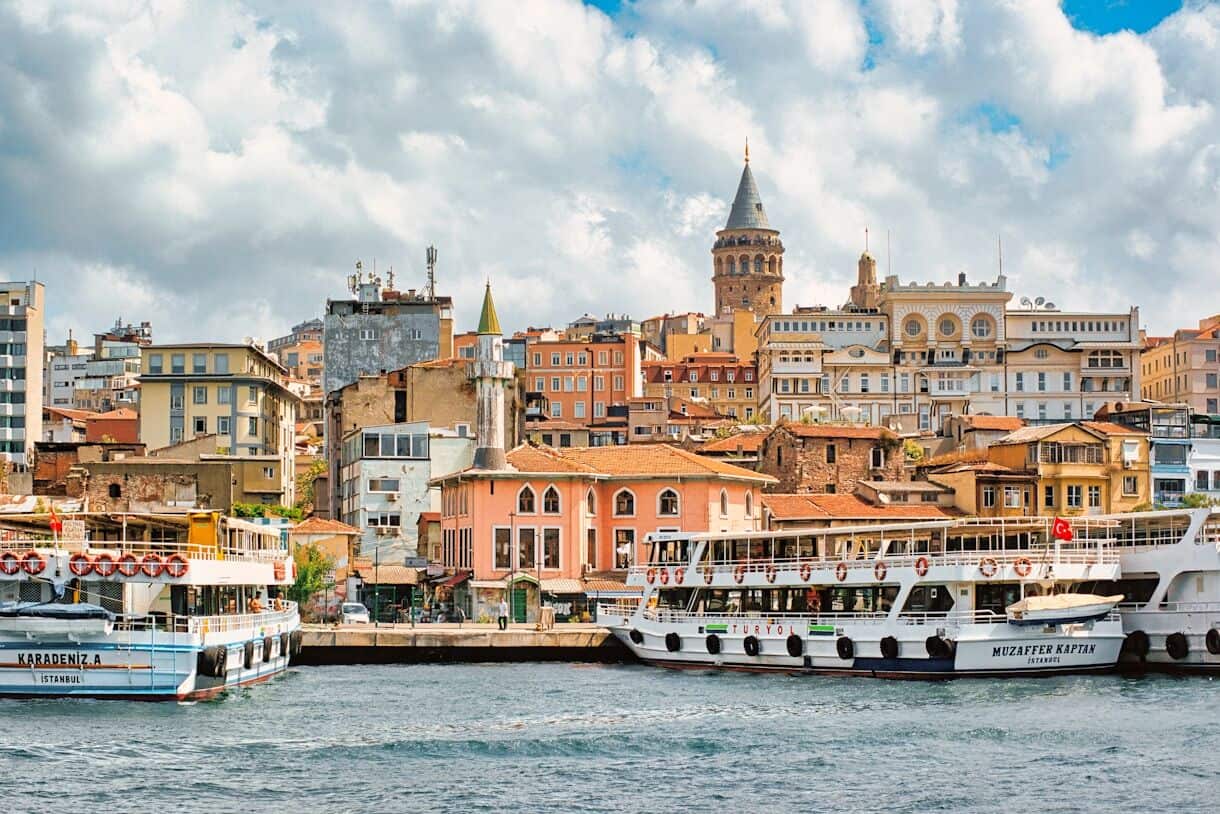
Sooner or later you’ll cross the Bosphorus, and the ferry is the way to do it. The crossings are cheap, frequent, and take 15 to 25 minutes depending on the route. The view of the European skyline from the water is one of the city’s best, and it costs less than a coffee.
The major commuter ferry routes are Eminönü to Kadıköy, Karaköy to Kadıköy, and Beşiktaş to Üsküdar. All four neighborhoods are worth visiting independently.
Kadıköy, on the Asian side, is where a lot of locals live and eat. The pace is calmer than Sultanahmet, the food scene is strong, and the Tuesday and Friday markets are some of the better produce markets in the city. The Moda neighborhood, a 15-minute walk south, has a long waterfront promenade and a concentration of cafes and small bookshops.
Üsküdar, further north on the Asian side, has a more conservative character and several important Ottoman mosques. The Maiden’s Tower, on a small island just offshore, is one of the city’s most photographed landmarks and is now open as a small museum after restoration.
For a longer trip, the full Bosphorus cruise runs from Eminönü up to Anadolu Kavağı near the Black Sea, taking about 90 minutes each way. The boats stop at several villages along the route, and you’ll see a Bosphorus most day-trippers never reach.
Beyoğlu and the European Side Beyond Sultanahmet
Crossing the Galata Bridge from the historic peninsula brings you into Beyoğlu, the European side’s modern core. Galata Tower, a 14th-century stone tower originally part of the Genoese colony’s fortifications, sits at the top of the hill. The observation deck has been the city’s main viewpoint for decades, though the queue can be long.
Istiklal Avenue runs through the heart of Beyoğlu and is the city’s main pedestrian shopping street. A historic tram still runs the length of it, and the side streets branching off contain the best concentration of bars, restaurants, and small music venues in the city. The Cihangir neighborhood, just south of Taksim Square, has become one of the city’s most desirable residential areas and has a calmer, more bookish character than the streets around Istiklal.
Karaköy, between Galata and the water, has rapidly transformed over the past decade into a design and food district. Third-wave coffee shops, contemporary art galleries, and several of the city’s best modern restaurants are clustered here. The Istanbul Modern museum reopened in 2023 in a new Renzo Piano-designed building on the waterfront.
Food
Istanbul’s food scene operates on at least three levels. Street food, family-run lokantas, and high-end restaurants each represent a different side of the cuisine, and a good trip rotates through all of them.
Street food worth seeking out:
- Simit, a sesame-crusted bread ring sold by vendors throughout the city. Best fresh in the morning.
- Balık ekmek, fish sandwiches served from boats and stalls at Eminönü.
- Kokoreç, grilled lamb intestine seasoned with herbs. An acquired taste but a local staple.
- Midye dolma, mussels stuffed with spiced rice and lemon, sold by street vendors particularly in Beyoğlu.
- Künefe, a hot dessert of shredded pastry, cheese, and syrup, best eaten at one of the dedicated shops in Sultanahmet.
For sit-down meals, the category to learn is the lokanta: a casual restaurant serving home-style food from steam trays. You point at what looks good, the staff plate it, and you eat for a fraction of what a tourist restaurant charges. Most lokantas are open for lunch only.
The meze culture is the other foundation. A meyhane meal involves a long table of small cold and hot plates, usually paired with rakı and stretched out over several hours. The Beyoğlu neighborhood has dozens of traditional meyhanes, with the Nevizade and Asmalımescit streets being the historic centers.
The Grand Bazaar and Spice Bazaar
The Grand Bazaar, one of the world’s oldest covered markets, has been operating since 1455 and contains over 4,000 shops across 61 covered streets. The experience is the point: the structure itself, the haggling, the density of goods. Realistic expectations matter. Most of what’s sold here is aimed at tourists, prices start high, and you’ll need to negotiate. Quality varies widely, and the best carpets, textiles, and jewelry are not necessarily in the most prominent shops.
The Spice Bazaar, also called the Egyptian Bazaar, sits near Eminönü and is smaller, more focused, and easier to walk through. Turkish delight, dried fruit, nuts, saffron, and the city’s signature pomegranate molasses are all available. The shops just outside the main building, on the side streets, often have better prices than the ones inside.
Hamams
A visit to a traditional Turkish bath is one of the experiences worth building into a longer trip. The format varies but typically includes a steam room, an exfoliation scrub on a heated marble platform, and a soap massage.
Three historic options:
- Çemberlitaş Hamamı, built in 1584 and the most central of the major historic hamams. Very tourist-oriented but the building itself is worth experiencing.
- Cağaloğlu Hamamı, built in 1741 and one of the most architecturally impressive baths still in use.
- Kılıç Ali Paşa Hamamı, originally built in 1580 and beautifully restored in 2012. Cleaner and more modernized than the others.
Newer hamams in business hotels offer the same basic experience in a more controlled environment, though without the historic setting.
Day Trips
If you have more than four or five days, several day trips work well as breaks from the city:
- Princes’ Islands, a group of nine islands in the Sea of Marmara reachable by ferry from Kabataş or Kadıköy. Cars are banned on most of the islands, and the pace is significantly slower than the mainland. Büyükada is the largest and most visited.
- Bursa, the early Ottoman capital, reachable by fast ferry and bus in around two and a half hours. Notable for early Ottoman architecture and the historic silk trade.
- Edirne, near the Bulgarian and Greek borders, with the Selimiye Mosque (a UNESCO site and one of the masterpieces of Ottoman architecture) as the main draw.
Practical Notes
A few things worth knowing before you go:
- The Museum Pass Istanbul covers most of the major historic sites and pays for itself if you visit three or more. Buy it at the first site you enter.
- Tap water is generally not consumed by locals. Bottled water is cheap and widely available.
- Friday afternoons see prayer crowds at major mosques. Plan visits to Hagia Sophia and the Blue Mosque outside those windows.
- Most museums are closed on Mondays.
- Bargaining is expected at bazaars and small shops but not in restaurants, supermarkets, or fixed-price stores.
- The best months for the city are April through May and September through October. Summer is hot and crowded; winter can be cold and wet but is much quieter.
The trips to Istanbul that disappoint are the ones that try to do it in two or three days. The city is too dense and too layered for that, and the result is a trip spent moving between sights rather than spending time in any of them. Five days is the realistic minimum. A week is better. Pick a base on one side of the city, cross the Bosphorus a few times, eat at the same place twice when you find one you like, and let the city open up at its own pace.
Featured image by Ibrahim Uzun on Unsplash
FOLLOW US ON INSTAGRAM


Information published on this website and across our networks can change over time. Stories and recommendations reflect the subjective opinions of our writers. You should consult multiple sources to ensure you have the most current, safe, and correct details for your own research and plans.