
The Battle of Los Angeles: What Really Happened on the Night of February 24-25, 1942?
By: Sarah Stone
Skip to Section
In the early morning hours of February 25, 1942, the skies over Los Angeles erupted in chaos. Air raid sirens screamed across the county, searchlights swept the darkness, and anti-aircraft batteries unleashed over 1,400 rounds of ammunition at an unseen enemy. By morning, the guns had fallen silent…but there was no enemy aircraft confirmed or wreckage recovered, and no real explanation offered for what had just happened.
The incident, now known as the Battle of Los Angeles (or the Great Los Angeles Air Raid), remains one of the strangest episodes of World War II on American soil. Depending on who you ask, it was either a case of war-induced mass hysteria, a genuine enemy incursion that the US government covered up, or perhaps even evidence of something not entirely of this world.
A City on Edge

To understand what happened that night, we need to set the mood for Los Angeles, February 1942.
Pearl Harbor was attacked not even three months earlier, on December 7. The shock of that assault – and the fact that America had now entered a World War – created widespread fear along the West Coast. If the Japanese could strike Hawaii, what was stopping them from hitting California?
This dread wasn’t purely paranoia. On February 23, just one day before the Battle of Los Angeles, a Japanese submarine surfaced near Santa Barbara and shelled the Ellwood oil field. There was minimal damage, but it proved that enemy vessels were operating in American coastal waters, so there was a significant psychological impact already.
Many large cities along the West Coast were already under blackout orders due to reports of Japanese submarines lurking nearby. Civil defense volunteers patrolled neighborhoods looking for light leaks, and residents were given instructions on what to do during an air raid. Los Angeles was primed for an attack that many believed was inevitable.
The Night of February 24-25, 1942
On February 24, naval intelligence issued a warning that there could be an air attack within the next 10 hours on California’s mainland. There was an alert at 7:18pm, causing thousands of air raid wardens to report to their posts, but that was lifted a couple of hours later. And then, at 2:15am, radar picked up an unidentified target approximately 120 miles west of Los Angeles. Six minutes later, the regional controller ordered a blackout, while the info center was inundated with reports of enemy aircraft. The region went to full alert, even though the original object seemed to have vanished.
“At 2:43am, planes were reported near Long Beach, and a few minutes later a coast artillery colonel spotted ‘about 25 planes at 12,000 feet’ over Los Angeles. At 3:06am a balloon carrying a red flare was seen over Santa Monica and four batteries of anti-aircraft artillery opened fire, whereupon ‘the air over Los Angeles erupted like a volcano.’ From this point on reports were hopelessly at variance.” – The Army Air Forces in World War II, Vol. 1 by William Goss
For the next hour, chaos reigned over the city. Searchlights crisscrossed the sky, and anti-aircraft guns thundered from positions all across the LA basin. Tracers and shell bursts lit up the darkness, and residents who had been jolted awake watched from their yards and rooftops, terrified and convinced they were witnessing an enemy attack in the middle of the night.
The all-clear sounded at 7:21am, and by then, batteries had fired an estimated 1,440 rounds of anti-aircraft ammunition into the night sky over Los Angeles.
The Aftermath of the Battle of Los Angeles
As the sun rose, so did the questions.
There was no enemy aircraft shot down, and no wreckage of any kind was recovered from the city or the surrounding area.
The Japanese government later stated that it had no aircraft over Los Angeles that night, and postwar analysis of Japanese military records confirmed this.
The US military shooting into the air had real consequences. At least five civilians died that night – three in car accidents caused by the blackout conditions and two from heart attacks attributed to the stress of the event. There was widespread property damage from falling shell fragments, with holes punched through roofs and cars across the city.
The official explanations were contradictory and unsatisfying. Secretary of the Navy Frank Knox held a press conference the next day, calling the incident a false alarm – that there were no planes over Los Angeles that night, and the incident was a result of jittery nerves.
Secretary of War Henry Stimson contradicted him, suggesting that 15 planes, possibly even commercial, operated by enemy agents had been over the city.
These conflicting accounts only fueled public suspicion that something was being covered up.
The Famous Photograph
-

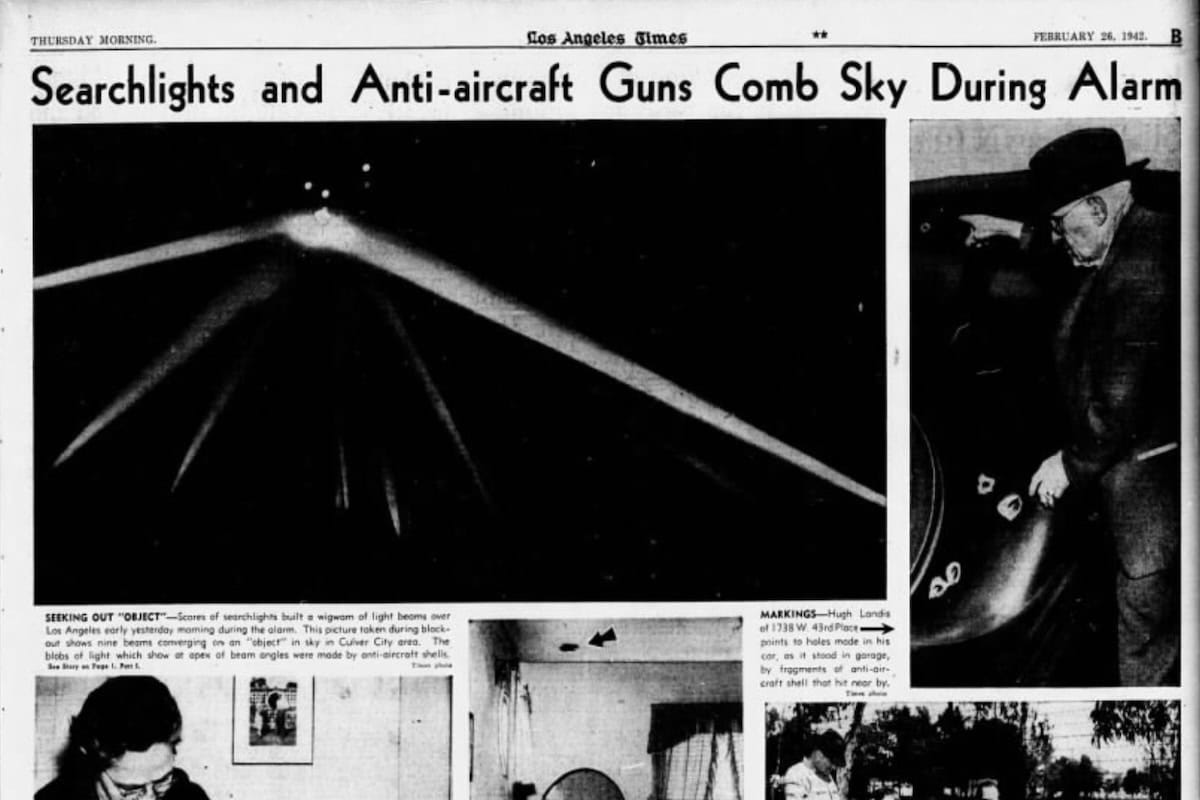
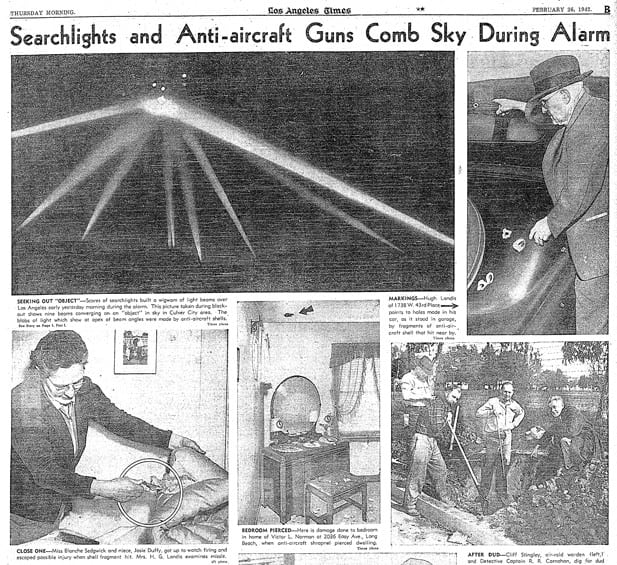
Image courtesy of Los Angeles Times via ProQuest on Wikimedia Commons.
One image from that night has become instantly recognizable: a photo published in the Los Angeles Times on February 26, 1942 showed searchlights converging on a bright, saucer-shaped object in the sky. To believers, this is the smoking gun – it appears to show a structured craft hovering in the sky, impervious to anti-aircraft fire.Historical context and modern discoveries give us a more earthly explanation. In 1942, it was standard practice for newspaper photo editors to heavily retouch images with ink and white paint (dodging and burning) to make sure they remained clear when printed on low-quality newsprint.
In 2011, researchers discovered the original, unretouched print in the Los Angeles Times archives. This version lacks the saucer-like defined edges of the published photo, and instead, it depicts a more amorphous, cloud-like glow where the searchlights come together. The object may be a combination of concentrated light, smoke from the 1,400 artillery shells, and possibly a high-altitude weather balloon. The “alien craft” seen today in UFO documentaries was largely a product of a 1940s graphic artist trying to make a dark, grainy photo readable for the morning edition.
The UFO Theory
The Battle of Los Angeles didn’t become a fixture in UFO lore immediately, but those theories did start popping up relatively early. As interest in unidentified flying objects grew in the postwar years – particularly after the 1947 Roswell incident and the Kenneth Arnold sighting that same year – researchers began looking back at earlier unexplained aerial events.
Proponents of the UFO theory point to several factors:
Are you stormtroopers?: The US military fired over 1,400 rounds at what the then-Secretary of War said were over a dozen enemy aircraft and hit nothing. If the targets were conventional aircraft (commercial, even – as suggested by Stimson), how did every single one escape unscathed? Anti-aircraft fire of that intensity probably should have brought down at least one plane, or at a minimum, left recoverable debris.
Eyewitness descriptions varied wildly: Some people reported seeing fast-moving objects in the sky, while others described slow-moving lights. Some saw nothing at all. UFO investigators argue that this inconsistency suggests that whatever was in the sky didn’t behave like conventional aircraft.
The official story kept changing: The immediate contradiction between the Navy and the War Department created suspicion that has never fully dissipated. If it was simply a false alarm, why the conflicting accounts?
The object behind the searchlights: While skeptics attribute this to retouching or optical effects, believers see a craft that matches descriptions of UFOs reported in later decades.
This wasn’t the only time: UFO researchers have also noted that 1942 was not an isolated year for strange aerial phenomena. Reports of foo fighters – unexplained lights that were said to follow Allied aircraft – would become common over Europe and the Pacific as the war progressed. Some see the Battle of Los Angeles as part of this broader pattern of unexplained wartime sightings.
The Conventional Explanations
Most historians and military analysts favor more mundane explanations for what happened that night.
Weather balloons: The most widely accepted theory holds that the initial radar contact and later visual sightings were caused by…weather balloons. If you remember the Roswell incident and later explanations, you’ll know the military was using meteorological balloons extensively at this time. One of those balloons could have drifted into the area, triggering the initial alert. A 1983 report by the US Office of Air Force History concluded that the incident was likely caused by meteorological balloons combined with “war nerves” and the heightened state of alert following the Ellwood shelling.
A cascade of false sightings: Once the first guns opened fire, the explosions and tracers in the sky created new targets for observers to report. The searchlights’ movement, along with smoke and shell bursts, could easily have created the illusion of multiple aircraft, especially to people unfamiliar with it. Crews at different battery positions, seeing the fire from other locations and the confusion in the sky, may have believed they were engaging real targets without communicating effectively with each other. Different observers, looking at the same chaotic sky from different angles, interpreted what they saw differently. The mind, primed to expect enemy aircraft, found patterns in the chaos.
Possible Japanese reconnaissance: Some researchers have suggested that a Japanese floatplane launched from a submarine may have been in the area, triggering the initial alert before withdrawing. Japanese submarines did carry small reconnaissance aircraft, and as mentioned, one had shelled the coast the previous day. No evidence supports this theory, however. Japanese records do not indicate any aircraft operations over Los Angeles that night, and the complete absence of any wreckage or physical evidence makes this explanation difficult to sustain.
Industrial smoke or flares: Other explanations have proposed that smoke from industrial facilities, signal flares from ships, or other civilian activity may have contributed to the confusion. Los Angeles was home to significant wartime manufacturing, and the combination of industrial activity and a city on high alert may have created conditions ripe for misinterpretation.
The Death Toll and Damage
Regardless of what caused the incident, its consequences were real.
Three people died in car accidents caused by the blackout conditions, and two others died of heart attacks attributed to the stress and excitement of the event – all of these people were civilians and had nothing to do with the incident.
There was extensive property damage, but thankfully, it wasn’t catastrophic. Shell fragments rained down across the city, punching holes in roofs, shattering windows, and damaging vehicles. Several buildings were struck by unexploded shells as well.
The psychological impact is harder to quantify. For residents who lived through that night, the memory stayed with them. Many remained convinced they had witnessed an enemy attack, regardless of what officials said afterward.
The Continuing Mystery of the Battle of Los Angeles
More than 80 years on, the official explanation – essentially, that nothing was there, and the whole incident was a case of jittery nerves and cascading false alarms – satisfies most historians. The context of the war, the attack on Ellwood the day before, and the city’s heightened state of alert all support this interpretation. Weather balloons or other regular aerial objects could easily have triggered an overreaction under those incredibly stressful, uncertain conditions.
But we all love the UFO lore – the combination of an unexplained aerial event, a compelling photo, and contradictory official statements makes it a great entry in the catalog of potential UFO encounters. For those inclined to believe, the Battle of Los Angeles gives evidence that unexplained craft were visiting Earth long before the modern UFO era began.
What actually happened that night? Probably nothing extraterrestrial. A city on edge, primed for an attack that never came, saw what it expected to see in the sky – and opened fire. The chaos that followed created its own confusion, and the conflicting explanations from officials did nothing to calm suspicions.
About the Author
As the editor in chief of Frayed Passport, my goal is to help you build a lifestyle that lets you travel the world whenever you want and however long you want, and not worry about where your next paycheck will come from. I've been to 20+ countries and five continents, lived for years as a full-time digital nomad, and have worked completely remotely since 2015. If you would like to share your story with our community, or partner with Frayed Passport, get in touch with me using the form on our About page.Featured image via Newspapers dot com.
FOLLOW US ON INSTAGRAM


Information published on this website and across our networks can change over time. Stories and recommendations reflect the subjective opinions of our writers. You should consult multiple sources to ensure you have the most current, safe, and correct details for your own research and plans.