
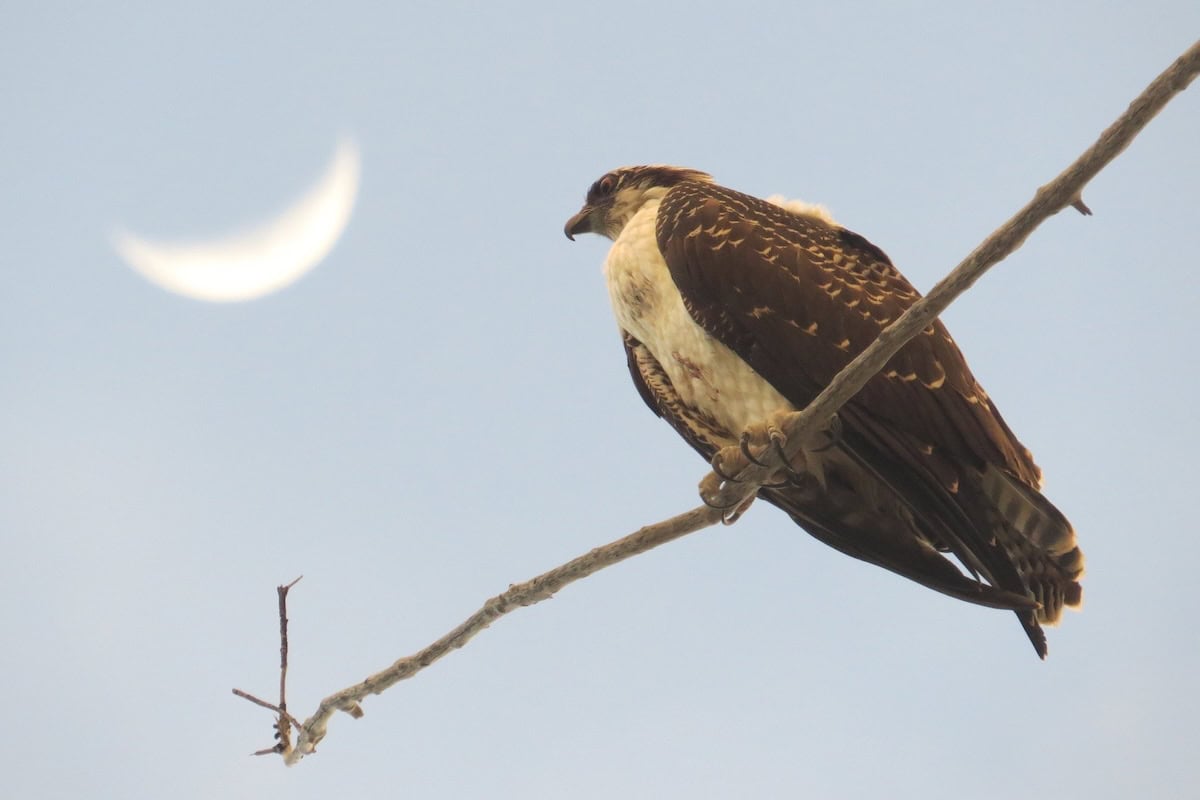
Hope Springs Eternal: Biking, Birding and Bathing in Central Florida
Skip to Section
As my wife and I finished yet another trip to Florida’s Sanibel Island—a Gulf Coast paradise packed with wildlife and seashells—a friend asked what was my favorite birding spot.
Rife with lagoons and refuges, Sanibel itself is terrific for birders; but I principally thought of Lake Apopka, just four hours north.


Tri-colored heron reflected in a pond on Sanibel.

Green heron in the Bailey Wildlife Tract on Sanibel.
Indeed, before that most recent Sanibel sojourn, my wife and I stayed three nights in the Central Florida city of Apopka—so we could bike at the nearby lake. But as it turned out, there’s a lot more happening in that area than just the state’s fourth-largest lake. Highlights included a manatee, a peacock and a planned 26-mile “spring-to-spring” trail—plus a natural, spring-fed lazy river that runs for nearly 4,000 feet.
Skip I-95
Located northwest of Orlando, Lake Apopka is best known for its amazing wildlife drive. That’s a free, one-way, 11-mile car-cruise open only on Fridays and weekends; we had driven it several times and came away bowled over by birds—not to mention gators galore.
But there are nearly 50 miles of interconnected hiking & biking trails near the lake, and we wanted to sample those. So we took advantage of Amtrak’s Auto Train, a daily 17-hour run between Lorton, VA (near DC), and Sanford, FL (near Orlando).
Among other things, this mode of transit sidesteps the headaches of airlines and interstates (indeed, Auto Train reservations are available at 1-877-SKIP-I95—no kidding). The train has sleepers and a diner, and you can bring your car—along with racked bikes (though there are length restrictions; see Amtrak’s website).
We dined on the train with a mother and son returning to their Orlando home, and the mom—Kathy—suggested we try other trails as well; there, she said, we’d find plenty of shade—unlike the largely treeless Apopka, which might fry us alive.
She had that right.
One and Done
Though we hit the trail early on a cloudless Saturday morning, we notched only nine miles, calling it quits after less than two hours. Since we regularly manage 8 mph, that reflects both how hot it got—and our many stops for photos:

Glossy ibis along the Lake Apopka Wildlife Drive.
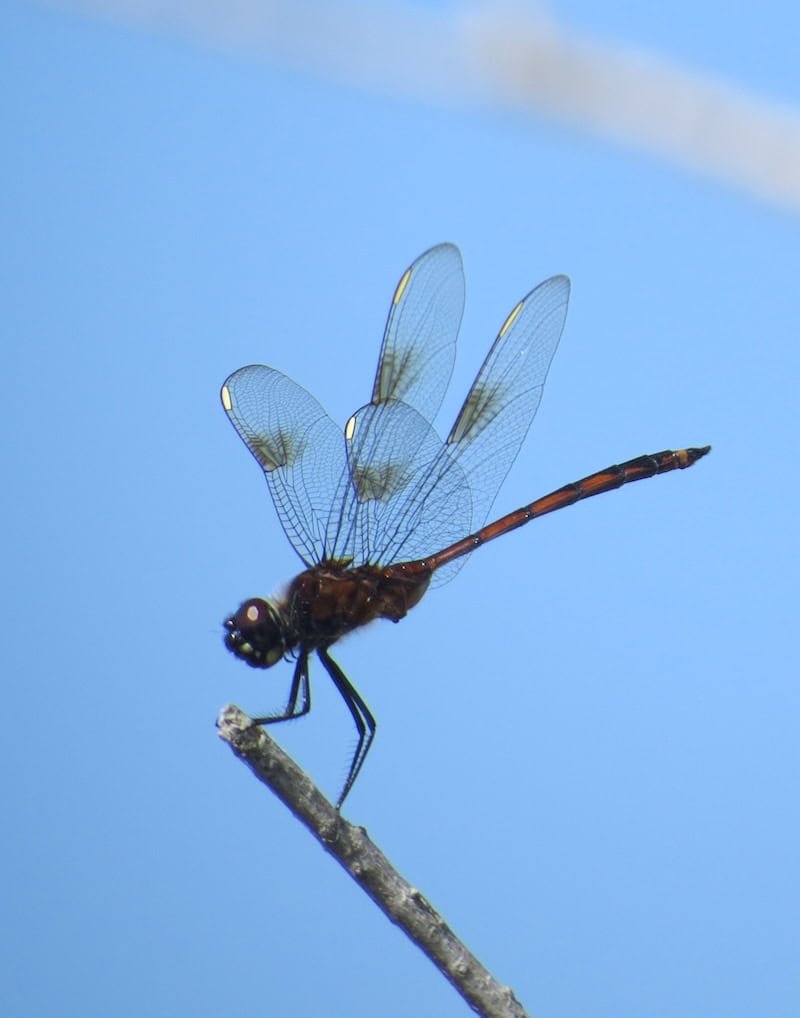
Dragonfly at Apopka.

Alligator showing off his jawline near the Historic Pump House at Lake Apopka.
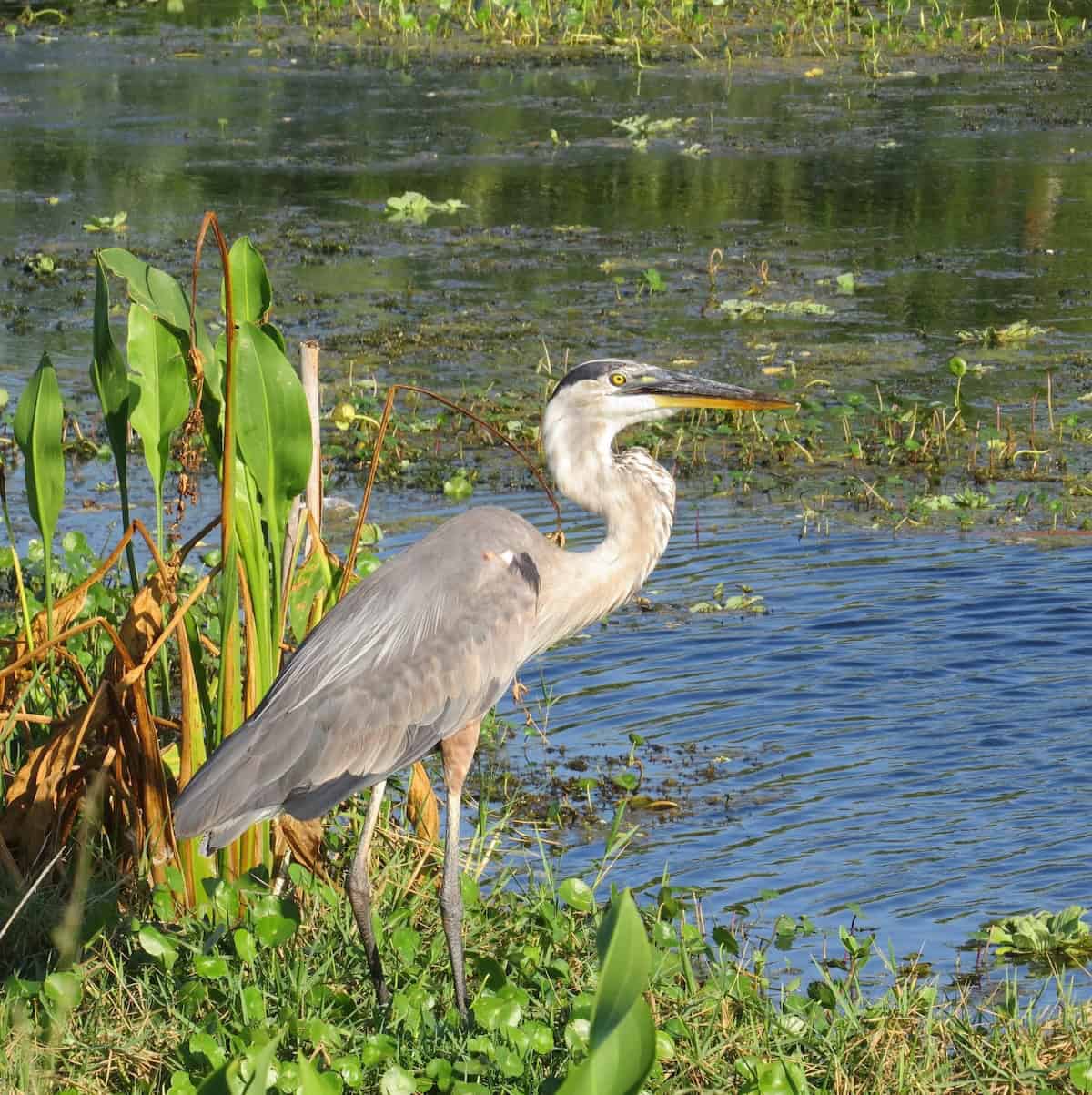
Great blue heron at Apopka.
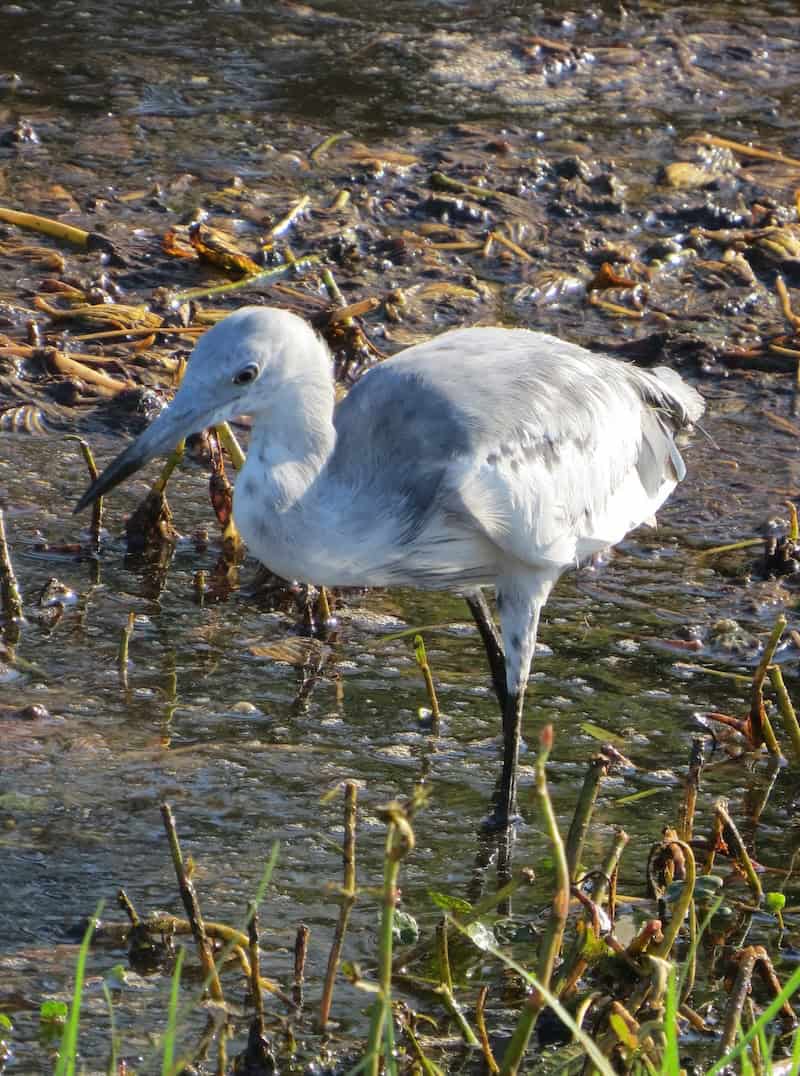
Juvenile blue heron at Apopka.

Gator at Apopka.
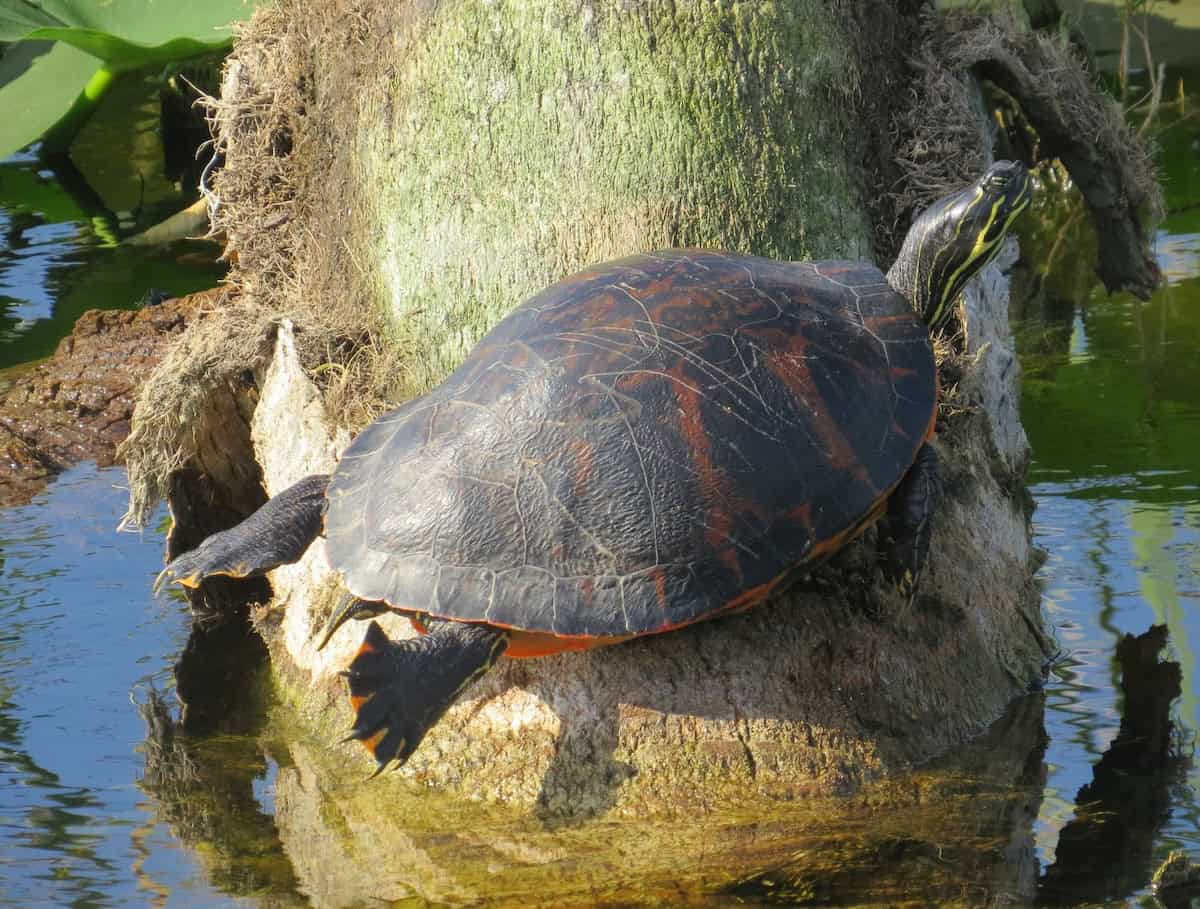
Turtle at Apopka.
Egrets, herons, anhingas, ospreys, gallinules, stilts, ibises, turtles and ducks of all kinds (the glowing, varicolored glossy ibis was a first for me). Stately great blue herons are everywhere; and like most birds at Apopka, they show little of the skittishness that elsewhere makes them hard to approach. We also spotted a juvenile little blue heron, with its lovely, soon-to-change color pattern of off-white and gray.
Alligators were likewise out in full force, with one or two showing off rows of fearsome teeth. Another first for me was the bird called a bittern (cleverly disguised as reeds, these are famously tough to spot); and on an earlier visit, I’d unwittingly photographed a gaggle of the rare fulvous whistling ducks—making at least one fellow-birder quite jealous.
“No Swimming”
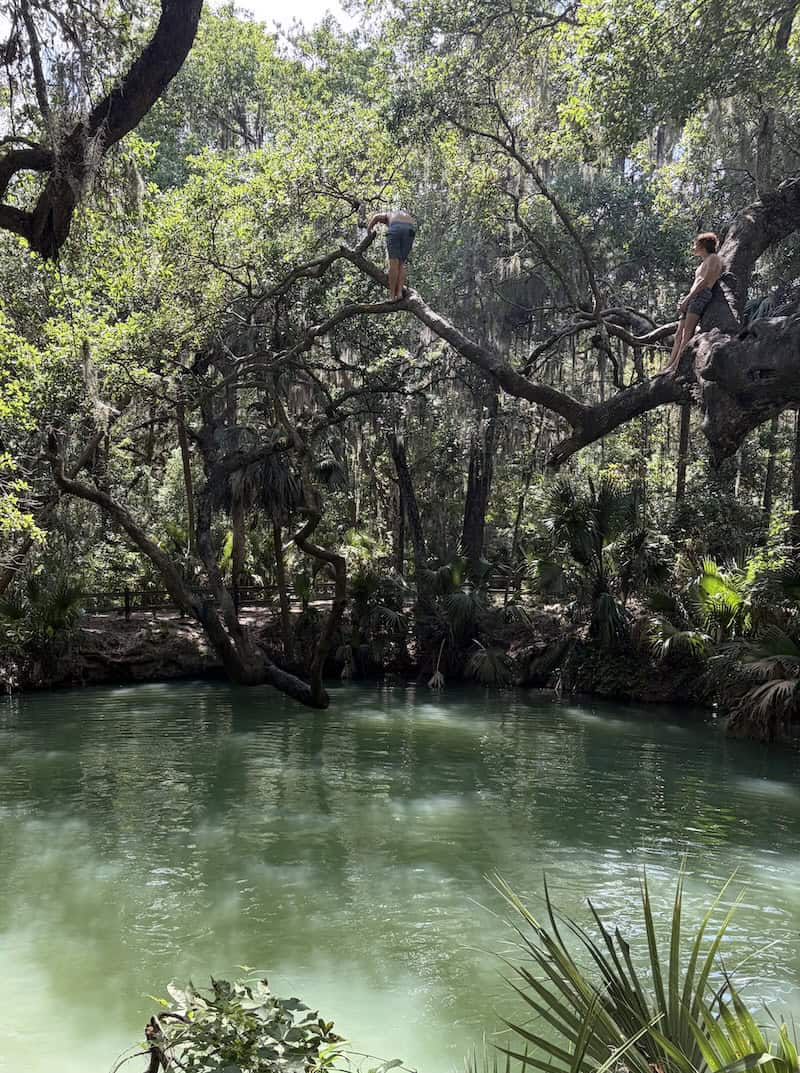
Green Springs Park in Florida, with swimmers preparing to hurl themselves in from the branch high above.
After a dandy brunch at the popular Twisted Biscuit up the road, we felt ready for more biking—but with a bit less sun this time around. So we headed to Blue Springs State Park—which turned out to be full, as it often is on weekends. Temporarily foiled (but planning to come back later), we took Kathy’s advice and tried nearby Green Springs instead.
It’s a small, free, quiet county park featuring shady trails and a modest-sized springhead—where a jade-green and utterly opaque pond spreads out under platform-like branches.
Several signs strictly forbade all swimming in the hole—so naturally, a half-dozen teen boys, and one intrepid girl, were spidering out along massive branches for noisy high-dives and backflips into the murk.
This despite the intense odor—from water so soaked in sulfur that Green Springs was formerly a health-mecca for both indigenous peoples and later generations of settlers (the latter built a hotel and spa on the grounds in the 19th century).
Best of all, Green Springs adjoins a well-maintained bike trail; it will eventually be part of a promising 26-mile “spring-to-spring” trail, connecting Gemini Springs in the south with DeLeon Springs in the north. Though no completion-date has been set, the county has finished 15 miles (in several pieces); its proposed route would offer multiple trailheads, including Lake Beresford, Lake Monroe—and Blue Springs, too.
Speaking of which:
Into the Blue
What do you think of when you hear the word springhead? If you’re like me, you picture a hole in the ground, where fresh water bubbles up gently from the earth.
At Blue Springs—which had reopened when we returned in early evening—the springhead is a broad, teal-colored pool around a vent that is literally 20 or 30 feet across; it puts out 100 million gallons a day. In summer, you can rent equipment in the park and snorkel right up to the vent. With certain limitations, you can even free-dive or scuba down into it; there’s a cave system over 100 feet below.

Free-diver above the 40-foot-vent at Blue Springs; those are trees that have fallen into this massive vent—which puts out a million gallons a day.

Manatee in the public swimming area at Blue Springs Park.
Though swimming is not allowed in winter—when manatees lounge safely in the clear, shallow water—the park has changing rooms, showers, concessions, a playground, a boardwalk with cooling sprinklers and easy access to the river; on this day it was packed with families using tubes and kayaks (these can also be rented onsite). And at one water entrance, a docent was carefully keeping bathers away from a manatee resting just a few feet off the platform.
The park also offers biking, hiking, birding, picnicking and exhibits; and, since its spring-run connects to the St. Johns River, boat tours and fishing are likewise available. It even has a few full-service cabins (kitchen, bath, etc.)—though these should be reserved well in advance.
Hidden Jewels
But our coolest discovery occurred the next day: Kelly Park Rock Springs, near Apopka. Though it’s a lesser-known county park, the place is so popular with locals that it took us four hours and four tries to get in—and then another hour before we entered the water, due to local thunderstorms.
But it was worth the wait.
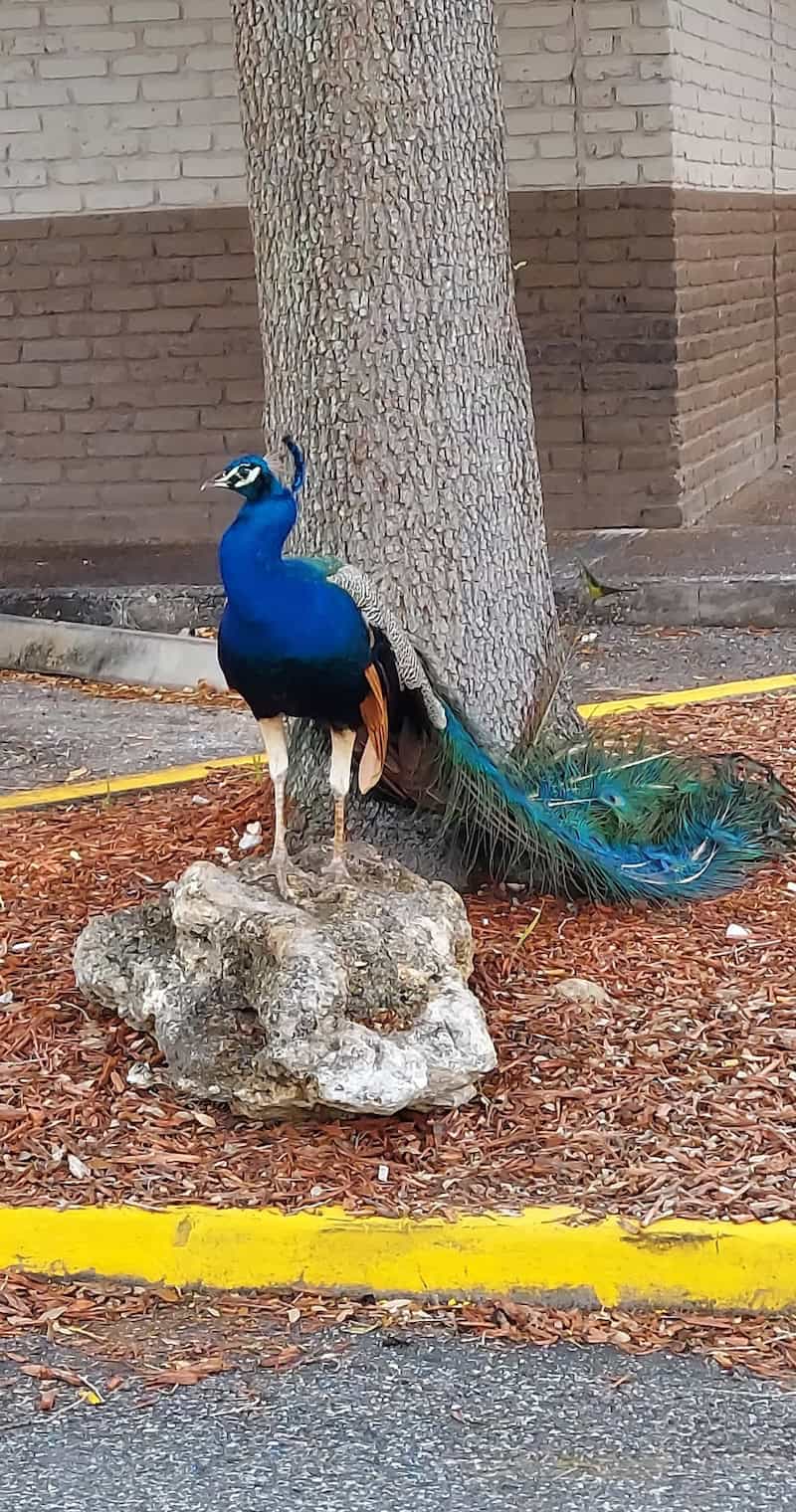
Peacock in the Burger King parking lot at Apopka, FL.
For one thing, the delay sent us to the Apopka Burger King for lunch—where we found a gorgeous male peacock strutting through the parking lot. I assumed it had escaped from a local farm—or perhaps that BK was updating its menu; but a birding friend assured me that these lovely fowl are now “established” (i.e., wild) in several parts of Florida.
As for Kelly Park:
Similar to Blue Springs, that bucolic spot offers shade, trails, camping, lockers, concessions and wildlife (beware those sneaky raccoons!)—plus a large, creek-fed swimming area. But the park’s centerpiece is its spring, which gushes instantly into an enchanting, nature-made “lazy river”—colored in shimmering shades of teal, turquoise and emerald. Varying in width and depth—and thus in the speed of its current—the creek runs rapidly through coves, rocks and shallows as it winds nearly a mile to a platformed exit, where a paved trail takes you back to the start.
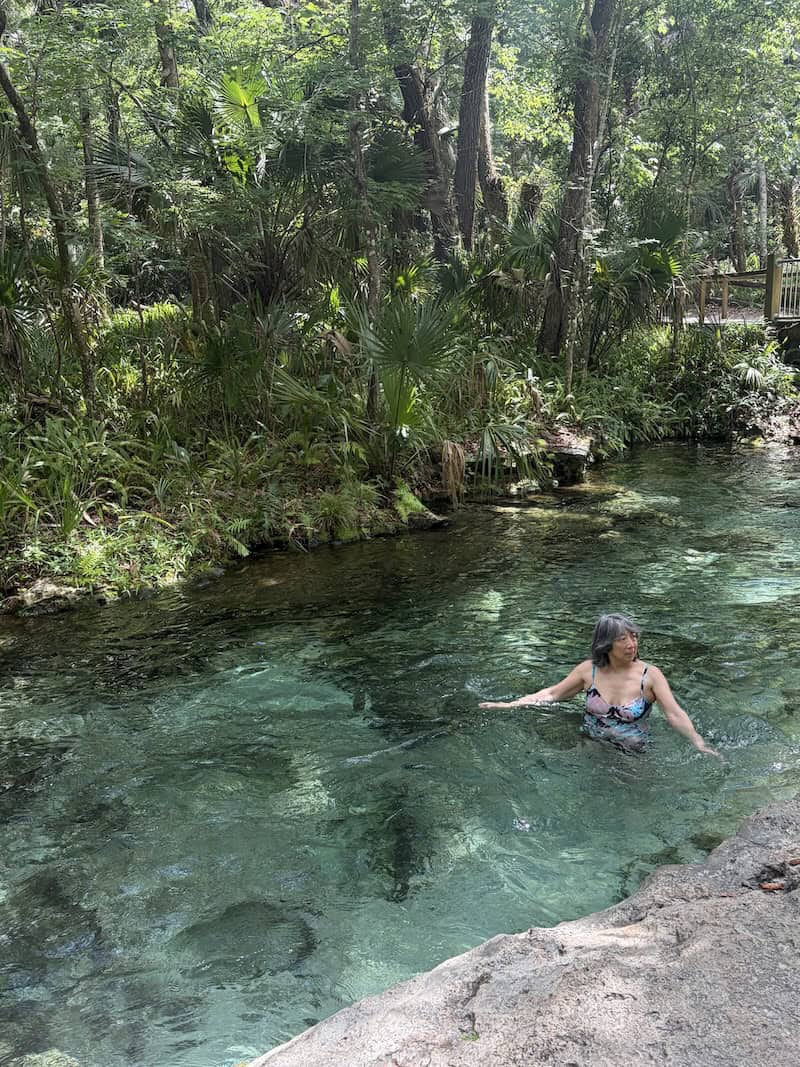
The author’s wife enjoys the sparkling natural lazy river at Kelly Park Rock Springs—near Apopka, FL.
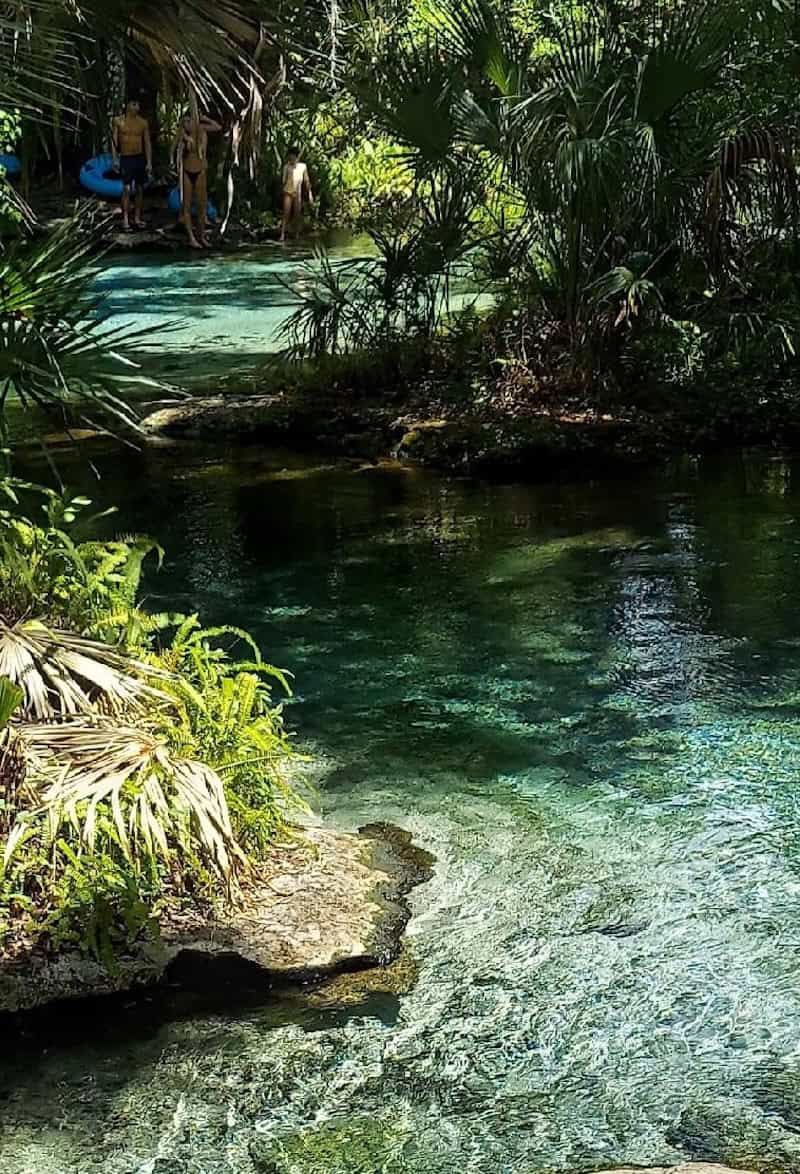
Tubers (top of frame) about to enter the natural lazy river at Kelly Park.

Raccoon hoping for a free meal at Kelly Park Rock Springs.
Fourth Time Lucky
This spatially constricted “ride” explains why the county cuts off entry after 280 vehicles. Kelly Park’s website—which will tell you when they’re full—indicates that some folks show up as early as 4:30 for the 8 a.m. opening. We arrived about nine and just missed the cut-off—at which point, officials handed out another 50 vouchers for a 1 o’clock retry. But they don’t allow a car-queue at that later hour, so we were turned away twice after showing up early (the second time, by a mere three minutes).
Both signage and the internet repeatedly insist the water is 68 degrees year-round; but I swim frequently in all kinds of water, and I assure you it was nowhere near that cold—at least not on this broiling May day.
The wildly varying depth can cause bumps and scrapes, so tubes might be a good idea; they’re available for rent—not in the park, but at a store near the entrance. You can also bring your own—even a noodle or two would help. (But beware of the park’s five-foot limit on flotation devices.)
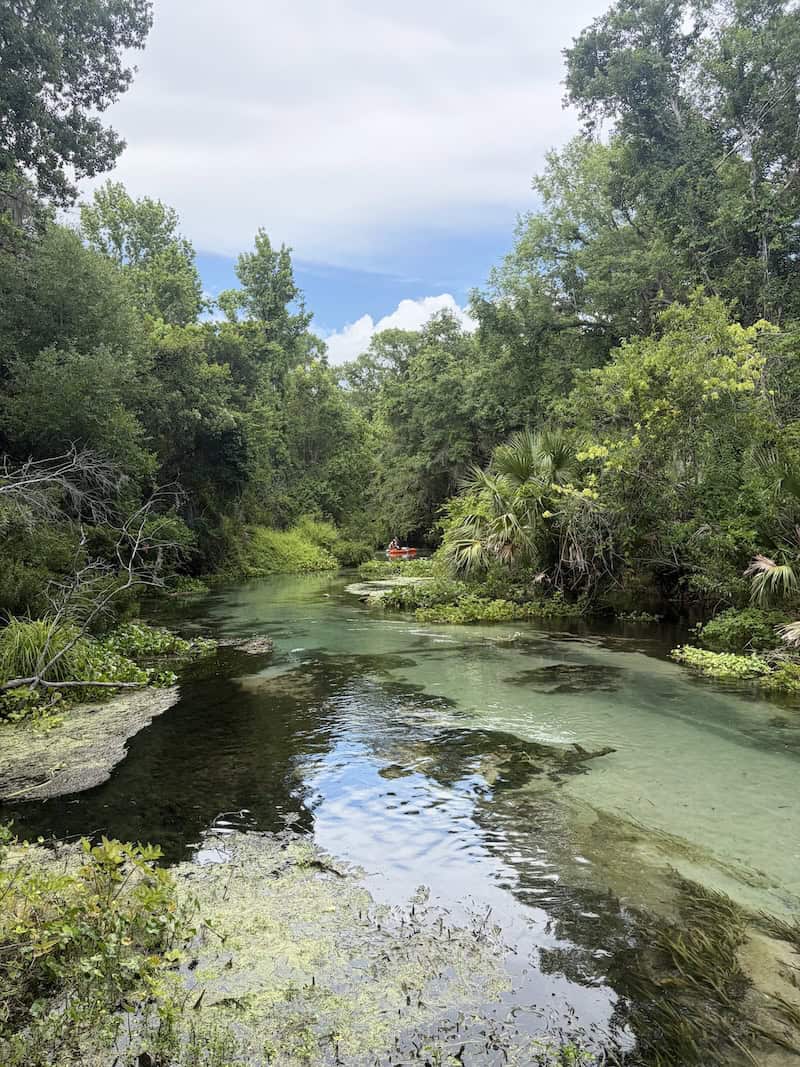
End of the run: Kelly Park’s spring-fed creek winds on past the swimmer-exit to a more open area for kayaks and canoes.
Going Back Again
Unlike Blue Springs, you cannot enter the spring itself, which is just a low hole in a vertical rock wall; but the initial pool is easily six feet deep, so I cannonballed in and sailed swiftly off. Since I grew up swimming in fast-moving water—in both the Niagara River and various Upstate New York parks—that current swept me right back to my childhood. I felt like I could’ve stayed all day.
We left determined to return—now that we know the ins and outs. In particular, we plan to bring some floats; to avoid Kelly Park on weekends; and maybe to get one of those cabins at Blue Springs.
If hangin’ out there is cool for the manatees, that’s good enough for us.
About the Author
Joseph W. Smith III is a writer, teacher and speaker in Central PA. Published in several websites and periodicals, Joe has also penned books on Hitchcock, the Bible, church life and under-the-radar movies—along with a volume of Great Jokes and Riddles. He plays trumpet in a community band; reads 100 books a year; serves as officer in his local church; struggles to keep cheering for the Buffalo Bills; listens to music whenever not sleeping; and maintains a small collection of unused postcards. He can be reached at robbwhitefan@gmail.com.All photos courtesy of the author.
FOLLOW US ON INSTAGRAM


Information published on this website and across our networks can change over time. Stories and recommendations reflect the subjective opinions of our writers. You should consult multiple sources to ensure you have the most current, safe, and correct details for your own research and plans.