

What Will International Travel Look Like in 2030? The Technologies Breaking Down Language Barriers
Skip to Section
Picture standing at a pharmacy counter in a country where you don’t speak a word of the language, trying to explain a symptom, or staring at a train ticket machine with a departure time you cannot read. These are not the dramatic moments travelers remember. They are the small, daily points of friction that quietly define how confident someone feels moving through a foreign country, and for decades the tools available to solve them – phrasebooks, dictionaries, and later a single translation app – have never quite closed the gap.
That is changing faster than most travelers realize. Live wearable interpreters, augmented reality overlays that translate the physical world in real time, and AI systems that check their own output before showing it to you are moving from novelty to everyday travel infrastructure. Based on current market data, expert commentary, and the direction the travel and language technology industries are already moving, here is what international travel is likely to look like by 2030.
The Trouble With Trusting Any Single Translation

Most travelers today rely on one translation app, and one app means one underlying AI model making a single guess at what a phrase, sign, or menu item means. That guess is usually close enough for small talk, but it is not built to catch its own mistakes.
One of the more mature branches of this shift is augmented translation technology, which layers AI-powered translation directly onto the physical world through a phone camera or a pair of smart glasses, rather than making a traveler stop, type, and wait for a separate screen. It is already changing how people navigate foreign cities, but most versions of it in the market today still lean on a single translation engine working alone, which means the underlying accuracy problem has not gone away. It has just been made more convenient.
The next five years are likely to attack that problem from two directions at once: making translation more physically seamless, and making the translation itself more trustworthy.
Prediction 1: Wearables Take Over From Apps
By 2030, expect fewer travelers holding up a phone to translate a conversation and more relying on hardware built for the job. Real-time translation earbuds, worn like ordinary wireless headphones, are forecast to grow from a US$314 million global market in 2024 to US$667 million by 2031, according to a QYResearch market report, a compound annual growth rate of 11.5 percent.
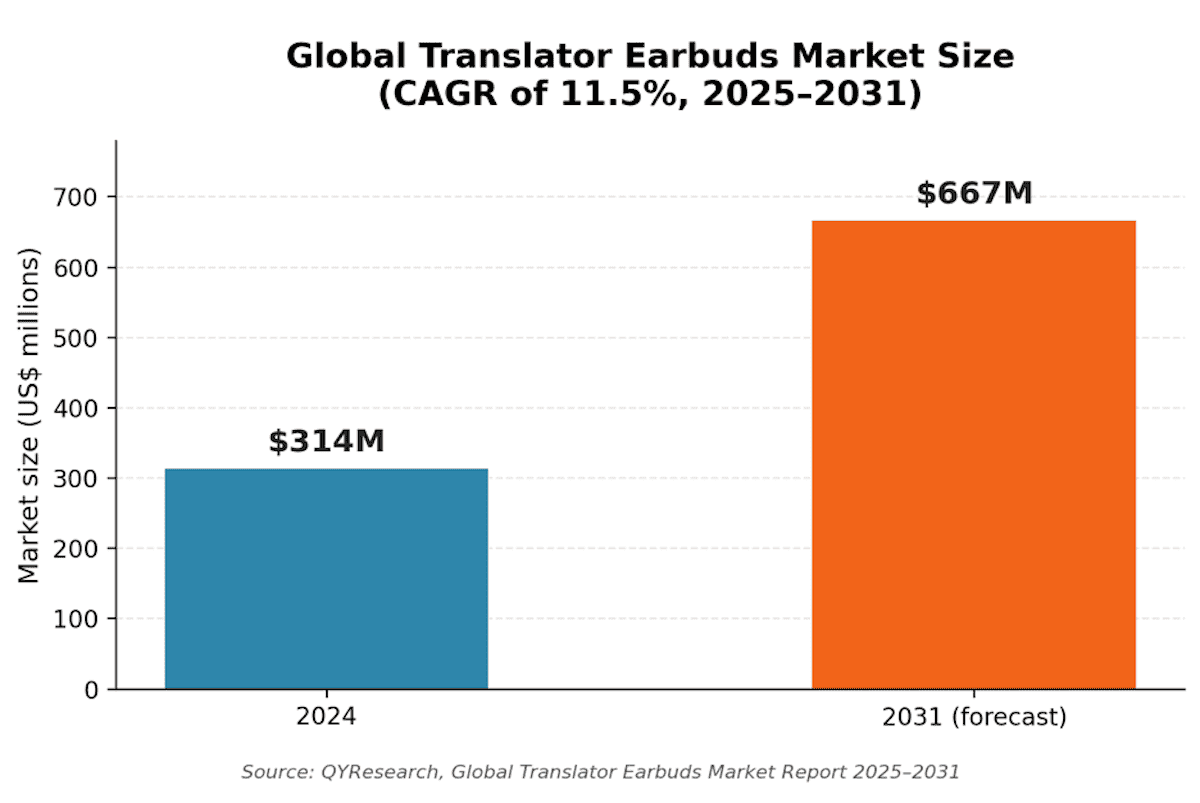
Global translator earbuds market size, 2024 vs. 2031 forecast
Smart glasses are moving in the same direction. Meta’s Ray-Ban glasses, updated in 2025 with live translation between English, Spanish, French, and Italian, translate spoken conversation and play it back through open-ear speakers while a paired phone displays a transcript, according to coverage in Multilingual magazine. For travelers, that points toward hands-free, real-time conversations with shopkeepers, hotel staff, and locals that do not require either person to look down at a screen.
Prediction 2: Streets, Menus, and Signage Get a Live Overlay
Augmented reality is set to become one of the fastest-growing technology categories of the decade, and travel is one of its clearest use cases. The global augmented reality market is projected to grow at a compound annual growth rate of 37.9 percent between 2025 and 2030, reaching close to US$600 billion by the end of the decade, according to Grand View Research.
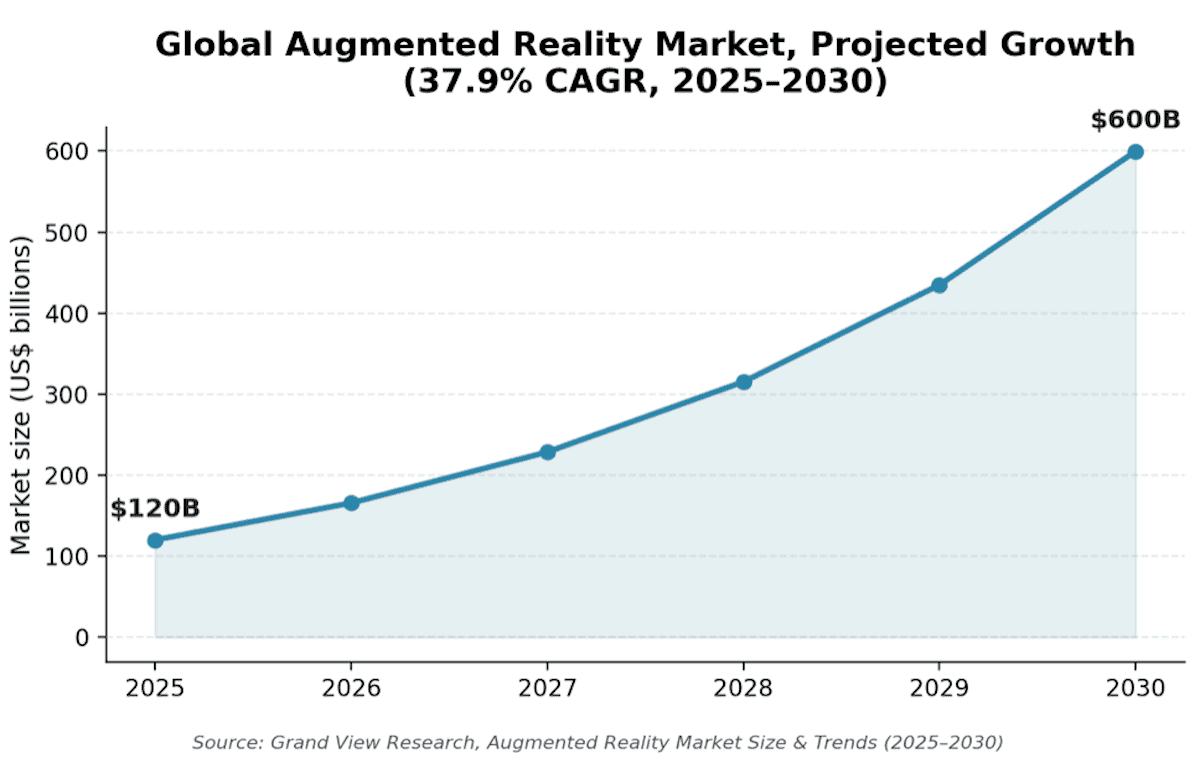
Illustrative growth trajectory of the global AR market based on Grand View Research’s forecast CAGR
For a traveler, that growth is likely to show up in ordinary moments rather than headline gadgets: a subway map that relabels itself in English as you look at it, a restaurant menu that translates itself through a phone camera before you order, a museum placard that narrates itself in your language as you walk past. None of this requires a traveler to learn a new tool. It requires the technology to disappear into the environment, which is exactly where AR is heading.
Prediction 3: Translation Stops Trusting Just One AI
“By 2030, the translation a traveler trusts will not come from any single AI model. It will come from several AI systems checking each other and agreeing on the same answer before a person ever sees it, the same way you would rather get a second opinion on something that matters,” said Ofer Tirosh, CEO of Tomedes, a professional translation company.
That shift toward consensus, rather than a single AI’s best guess, is already visible in industry research. Intento’s State of Translation Automation 2025 report found that multi-agent translation workflows, which combine several models, review, and post-editing into one process, outperformed every individual model tested, and that the gap between human and AI translation quality has largely closed for well-supported languages. For everyday travel phrases, that means the next generation of translation tools is less likely to hand a traveler one AI’s confident but occasionally wrong answer, and more likely to cross-check that answer against several other systems first.
The practical effect for travelers is less second-guessing. Right now, a traveler who gets an odd-sounding translation has no real way to know if it is wrong, just different-sounding. A consensus-based approach is built to catch exactly that kind of quiet error before it reaches the person relying on it.
What This Means for the 1.8 Billion Travelers of 2030
None of this matters in the abstract. It matters because the number of people crossing borders every year keeps climbing. The UN World Tourism Organization’s long-range forecast, Tourism Towards 2030, projects international tourist arrivals will reach 1.8 billion by 2030, up from a pre-pandemic peak of roughly 1.46 billion in 2019, meaning an average of 43 million additional international tourists join the travel market every year.
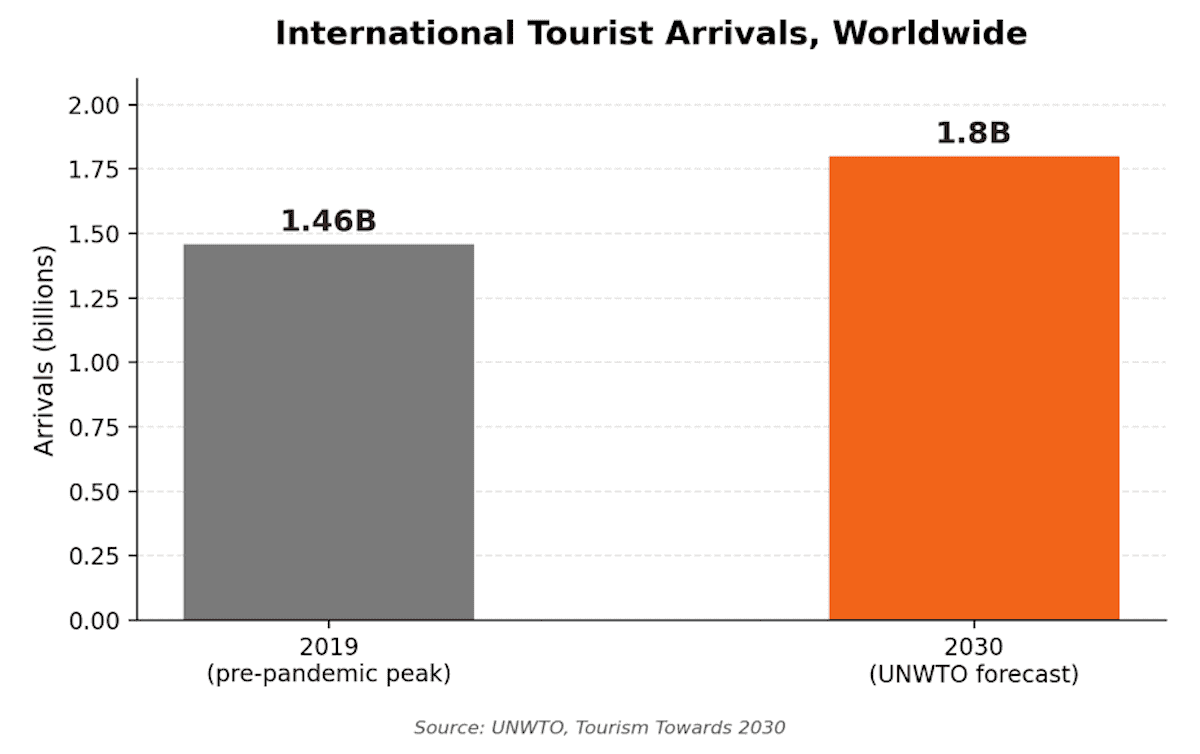
International tourist arrivals, 2019 actual vs. 2030 UNWTO forecast
More travelers means more daily moments where language is the only thing standing between a smooth trip and a frustrating one. The technologies converging by 2030, wearable interpreters, ambient AR translation, and AI systems built to double-check themselves, are not solving a niche problem. They are catching up to a genuinely global one.
The travelers who benefit most will not be the ones who buy the newest gadget first. They will be the ones who understand that the biggest shift is not a device at all. It is translation finally being built to question itself before it reaches you, rather than asking you to take one AI’s word for it.
Featured image by Liliana Drew on Pexels
FOLLOW US ON INSTAGRAM


Information published on this website and across our networks can change over time. Stories and recommendations reflect the subjective opinions of our writers. You should consult multiple sources to ensure you have the most current, safe, and correct details for your own research and plans.