
Unmissable Experiences Guide to Costa Rica: Adventures Worth Building a Trip Around
Skip to Section
Costa Rica packs more variety into a small country than almost anywhere else in the Americas. The total land area is smaller than that of West Virginia, and it’s home to rainforests, cloud forests, dry forests, two coastlines, active volcanoes, plus roughly 5 percent of the world’s biodiversity. The country also has a stable democracy, no army (abolished in 1948), and a longstanding commitment to conservation that has shaped its approach to tourism.
It’s a destination where you can take six (or more!) kinds of trips without leaving the borders. Here’s a closer look at the experiences that consistently rank among travelers’ top memories, with practical details on how to plan each one.
Wildlife Watching in Tortuguero

Tortuguero National Park sits on the Caribbean coast in the northeast of the country and is one of the best wildlife destinations in Costa Rica. The park is roughly 77,000 acres of protected wetlands, rainforest, and beach, and it’s accessible only by boat or small plane. There are no roads in.
The park’s most famous draw is sea turtle nesting. Green sea turtles lay eggs on the beach between July and October, with peak activity in August and September. Leatherbacks nest from March through June. Park rules limit beach access at night and require visitors to go with a licensed guide during nesting season, both for the turtles’ safety and for control of crowds.
Beyond turtles, the canal network through the park is one of the better places in Central America to see wildlife from a boat. Caimans, sloths, three species of monkey, river otters, and over 300 species of birds are all common. Guided kayak trips and small-boat tours run from most lodges and typically depart at dawn or just before dusk, which is when wildlife is most active.
Eco-lodges are the standard accommodation format here. Many are built into the forest with raised walkways and limited electricity, and they generally include guided activities in the rate. Mawamba Lodge, Tortuga Lodge, and Pachira Lodge are among the better-established options.
San José for City Days and Food
San José is the country’s capital and largest city, and many travelers skip it on their way to the coast or the volcanoes. If you have two or three days you can spend here, it’s a fantastic spot – especially for the food and culture.
The Mercado Central, running since 1880, is the standard introduction to the city’s food scene. Sodas (small family-run restaurants) inside the market serve traditional dishes at low prices: gallo pinto for breakfast, casados for lunch, and a strong line in fresh tropical fruit. Patacones (twice-fried plantain) and tamales are both worth ordering. The Feria Verde on Saturday mornings is the city’s main farmers market and a better window into contemporary Costa Rican food.
Cultural sites you might love:
- The Pre-Columbian Gold Museum, beneath the Plaza de la Cultura, has one of the best collections of indigenous goldwork in the Americas.
- The Jade Museum houses the largest collection of pre-Columbian jade in the world.
- The National Theater – a late 19th-century opera house that’s still in active use.
- Barrio Escalante, the city’s restaurant and bar district, with the densest concentration of independent kitchens and coffee shops.
Nightlife is strong, particularly Thursday through Saturday. Live music venues like Jazz Café and El Sótano cover most genres, and the dance club scene around San Pedro caters to a younger crowd. The city is safer than its reputation suggests in the central neighborhoods, but standard urban precautions apply.
Offshore Fishing from Flamingo Marina
Costa Rica’s Pacific coast is one of the world’s premier sport fishing destinations, and Flamingo Marina, in the Guanacaste region, is among the best-equipped departure points. The marina sits on a sheltered bay with deep water access close to shore, which cuts down on the time spent transiting from the dock to the fishing grounds.
The fishery breaks into two main categories:
- Offshore, for billfish and pelagics. Pacific sailfish, blue marlin, black marlin, yellowfin tuna, dorado, and wahoo are all targets, with seasonality varying by species. Sailfish peak from December through April. Marlin are most active from August through November. Tuna and dorado run year-round with seasonal peaks.
- Inshore, for reef and structure species. Roosterfish, snapper, jack, and grouper are the main targets, and inshore trips are often a better fit for beginners or families with kids.
Costa Rica fishing charters typically run as half-day or full-day trips with a captain and at least one mate, and most boats are equipped for both offshore and inshore, depending on what you want to target. Tackle, bait, ice, and usually lunch are included. Catch-and-release is standard for billfish and increasingly the norm for marlin and sailfish across the industry.
For families, an inshore half-day is the easier introduction. Shorter run times, calmer water, more frequent action, and species that are manageable for kids to reel in.
The Monteverde Cloud Forest
Monteverde is a cloud forest reserve in the country’s central mountain range, at an elevation of roughly 4,600 feet. The constant mist and high humidity create a distinct ecosystem that supports species you won’t find at lower elevations, including the resplendent quetzal (best viewed January through May during the breeding season) and over 100 species of mammals.
The reserve covers around 35,000 acres and is one of the most-visited natural sites in the country, so going early or staying overnight nearby can make a real difference to the experience. Tours arrive en masse from late morning.
The main activities:
- Trail hiking. The reserve has eight main trails ranging from 30 minutes to most of a day. The Sendero Bosque Nuboso and the Sendero El Camino are the most popular.
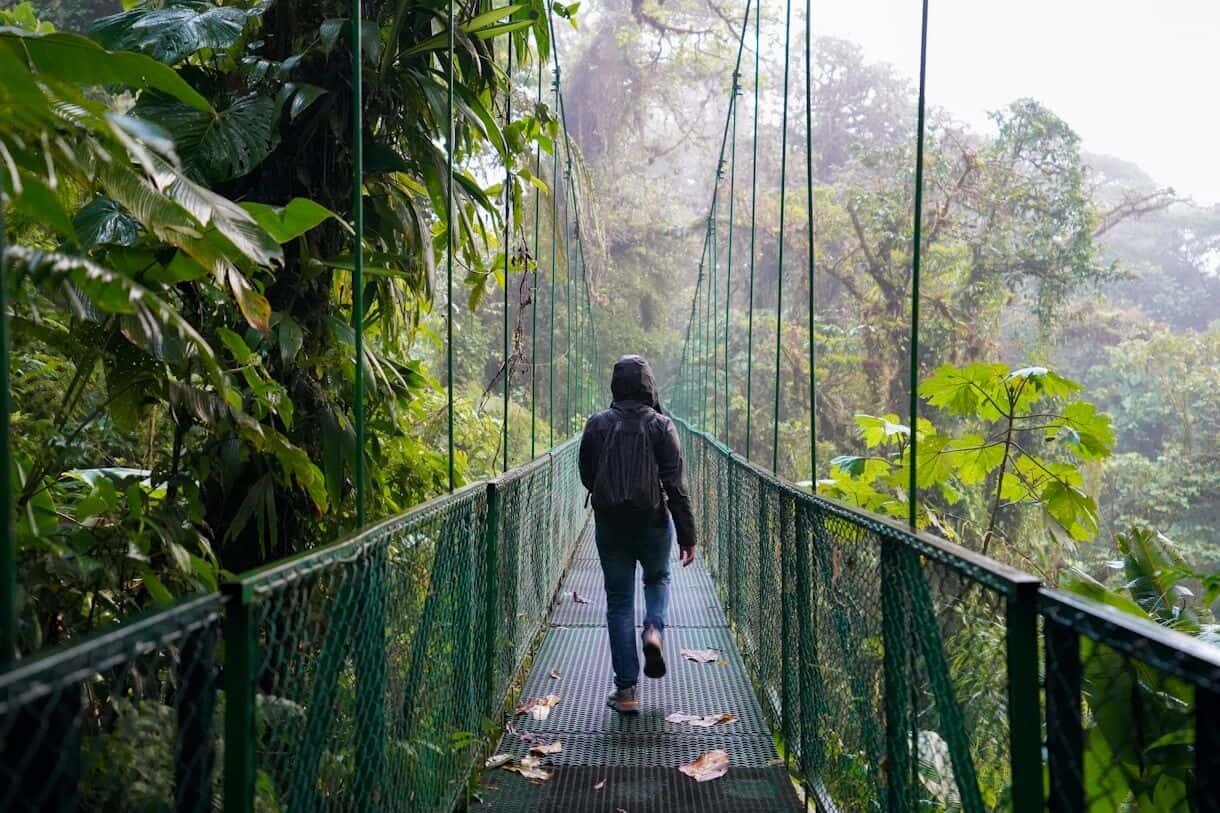
- Hanging bridges. A network of suspension bridges through the Monteverde Cloud Forest canopy gives you a view of the forest from a different vertical layer than ground-level hiking. Selvatura and Sky Adventures are the two main operators.
- Zip lining. The cloud forest is one of the original homes of canopy zip lining as a tourism activity. Multiple operators offer routes through the forest at varying intensity levels.
- Orchid and butterfly gardens, both of which are educational stops that work well in the heat of midday.
- Night hikes, which run with a guide and a flashlight and produce sightings of nocturnal species you won’t see during the day.
Bring layers. The cloud forest is significantly cooler than the coast, and rain is possible any day of the year.
Manuel Antonio Beaches
Manuel Antonio National Park, on the central Pacific coast, is the country’s smallest national park and one of its most popular. The draw is the combination of rainforest and white-sand beaches, with wildlife visible from the beaches within Manuel Antonio National Park.
The park has four main beaches:
- Playa Manuel Antonio, the most popular and the most family-friendly, with calm water and a horseshoe-shaped bay.
- Playa Espadilla Sur, longer and less crowded, with rougher surf.
- Playa Gemelas, smaller and more secluded, requiring a short hike from the main trail.
- Playa Escondido, the least visited, accessible only at low tide.
Capuchin monkeys, sloths, agoutis, and iguanas are routinely visible from the trails and beaches inside the park – but don’t feed any of them! The monkeys in particular have become aggressive about food, and feeding them is illegal and damages the ecosystem.
The park is closed on Tuesdays and has a daily visitor cap, which has helped reduce overcrowding. Buy tickets online in advance, especially in the December-April high season. Arrive at opening (7am) for the best wildlife viewing and to beat the crowds and heat.
A sunrise walk on the public Playa Espadilla, outside the park, is one of the better-kept tips for the area. The beach is empty, the air is cool, and the light is good for photos before the day-trippers arrive.
A Few Other Experiences Worth Considering
If you have more than a week, a few additional experiences round out a Costa Rica trip well:
- Arenal Volcano and the hot springs around La Fortuna. The volcano hasn’t erupted since 2010, but the thermal infrastructure remains and several lodges have natural hot spring access on site.
- The Osa Peninsula, in the far south. Often called the country’s last frontier, with Corcovado National Park as the wildlife centerpiece. Harder to reach and less developed than Manuel Antonio.
- Rio Celeste, in Tenorio Volcano National Park. A bright blue river created by a mineral reaction at the confluence of two clear streams. Best visited in the dry season when the color is at its most intense.
- Coffee farm tours in the Central Valley. The country produces some of the best arabica in the world, and several farms run informative tours that finish with a cupping.
Featured image by J. Amill Santiago on Unsplash
FOLLOW US ON INSTAGRAM


Information published on this website and across our networks can change over time. Stories and recommendations reflect the subjective opinions of our writers. You should consult multiple sources to ensure you have the most current, safe, and correct details for your own research and plans.