
The Art Deco Enigma: Glamour, Design and Untold Tales
By: Frayed Passport
Skip to Section
Sharp lines, expensive materials, and glamour with no apology attached. Art Deco hit its peak between the two World Wars, and it turned up in nearly everything people looked at, from skyscrapers to cigarette cases.
The style read as optimism made physical. It celebrated machines, speed, and a future that seemed worth showing up for, and it became the visual signature of the Jazz Age.
Birth of a Dazzling Style

Most accounts pin the beginning to the 1925 Exposition Internationale des Arts Décoratifs et Industriels Modernes in Paris, which is close enough for a headline but not quite right. That fair had been approved back in 1912 and was originally scheduled for 1915 before the First World War pushed it back a decade. Plenty of what visitors saw in 1925 had been designed years earlier and simply put in storage.
What the fair actually did was broadcast the style to an international audience. The look itself had been developing in France for years, and it moved in the opposite direction from Art Nouveau’s curving, plant-inspired shapes. Instead you got hard geometry, symmetry, and machine-age materials like chrome and polished steel.
The influences came from odd corners. Cubism supplied the sharp angles. The 1922 opening of Tutankhamun’s tomb set off a wave of Egyptian motifs. Airplanes, ocean liners, and automobiles contributed the streamlined shapes. The result was sophisticated and immediately readable, which is a rare combination and a large part of why it spread so fast.
The Style That Had No Name
Here’s the part that surprises people. Nobody in the 1920s or 30s called any of this Art Deco. At the time it went by “le style moderne,” the modern style, or simply “the 1925 style.”
The name arrived roughly 40 years later. A 1966 retrospective in Paris revisited the era, and a British historian’s 1968 book, “Art Deco of the 20s and 30s,” gave the movement the label that stuck. Every building you think of as Art Deco was finished long before anyone applied the term to it.
Art Deco Landmarks Worldwide
Certain buildings come to mind immediately. New York’s Chrysler Building, with its stacked steel crown, and the Empire State Building are the ones most people picture. Both reached for altitude at a moment when height itself was the argument.
Los Angeles has the Eastern Columbia Building, a 1930 tower faced in blue-green terra cotta with copper and gold leaf accents and a clock tower wrapped in buttresses. Griffith Observatory usually gets filed under Art Deco too, though the truth is messier: it combines Greek and Beaux-Arts elements with Moderne influences, which was typical of how California architects handled the style.
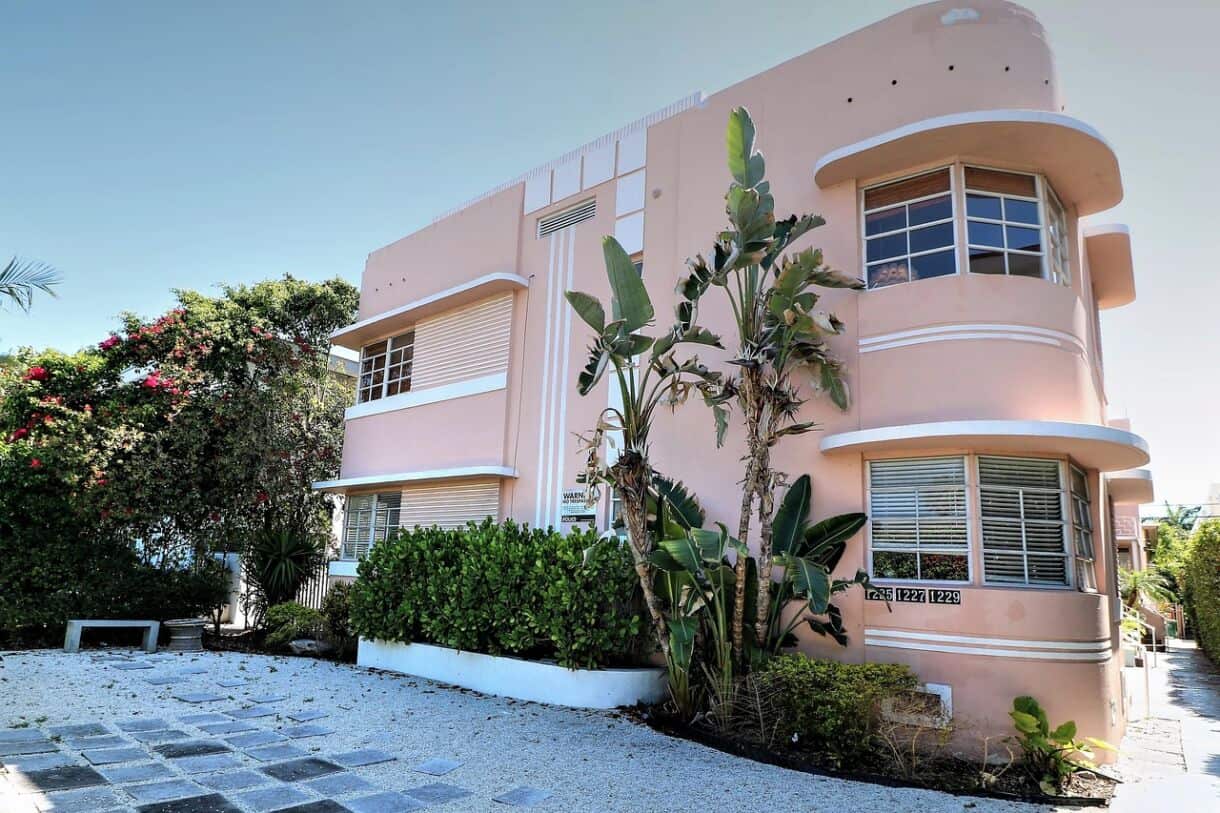
Miami Beach holds the largest concentration anywhere, and it nearly didn’t survive. Much of South Beach was slated for demolition in the 1970s until a preservation campaign fought it building by building, sometimes literally standing in front of bulldozers. On May 14, 1979, more than 800 structures were listed as the Miami Beach Architectural District, making it the first urban 20th-century historic district on the National Register of Historic Places. The pastel color palette that now defines Ocean Drive was chosen during that restoration, not in the 1930s.
The style still pulls at architects and designers. You’ll find its influence handled carefully in a contemporary downtown hotel in Boston, where historic detail meets what modern travelers actually want from a room.
Hidden Symbolism in Design
The repeating patterns weren’t decoration for its own sake. They carried meaning that people at the time read fluently.
Sunbursts and sunrises, usually placed above doorways or worked into metalwork, stood for a new day after the wreckage of the First World War. Zigzags and chevrons signaled speed and electricity, the visual equivalent of jazz. Stylized gazelles, greyhounds, and diving birds appear constantly, all of them shorthand for grace and motion.
Read together, the geometry makes an argument about order and forward motion in a world that felt like it was accelerating past anyone’s ability to keep up.
Experiencing Art Deco Today
You don’t need a museum ticket. Walk the older commercial blocks of almost any city that grew between 1920 and 1940 and look above the ground floor, where storefront renovations rarely reach. Decorative friezes, geometric brickwork, stepped rooflines, and metal spires survive up there in quantity.
Movie palaces from the same era are worth hunting down. Many have been restored, and watching a film inside one gives you the period experience the architects intended, right down to the lobby.
Bank lobbies, post offices, and old municipal buildings reward a look inside too. Public architecture from the 1930s tends to have survived better than commercial interiors, since nobody had a financial reason to gut it.
The Enduring Appeal of Glamour
A century past its peak, the style still holds attention. The balance is what does it: opulence held in check by order, luxury that still had to function.
Art Deco calls up an era of confidence and belief in progress, which reads as both nostalgic and oddly current depending on your mood. Designers keep reinterpreting it in fashion, graphic work, and interiors without it ever looking dated, largely because the underlying geometry is simple enough to survive translation.
The lasting glamour comes down to conviction. Somebody decided a bank lobby deserved bronze grillwork and a marble floor, and a century later you can still walk in and feel that decision.
FOLLOW US ON INSTAGRAM


Information published on this website and across our networks can change over time. Stories and recommendations reflect the subjective opinions of our writers. You should consult multiple sources to ensure you have the most current, safe, and correct details for your own research and plans.