
The Route 66 Centennial: Celebrating 100 Years of the Mother Road in 2026
By: Heather Keys
Skip to Section
Route 66 turns 100 in 2026!
The highway that carried Dust Bowl migrants westward, inspired a hit song and television series, and became a symbol of American freedom and mobility has reached its centennial, with celebrations happening across all eight states that it once connected.

If you’ve ever wanted to drive the Mother Road, this is the perfect year to do it.
A Brief History of Route 66

Established on November 11, 1926, US Route 66 spanned 2,448 miles (depending on the route alignment you use) from Chicago to Santa Monica through Illinois, Missouri, Kansas, Oklahoma, Texas, New Mexico, Arizona, and California. It was one of the first continuously paved highways in the country and, during its heyday, the primary route for Americans migrating west.
The highway’s beginnings are largely thanks to Cyrus Avery, a Tulsa businessman and Oklahoma highway commissioner who served on the federal board that created the US Highway System. Avery championed a Chicago-to-Los Angeles route that dropped south through Oklahoma before turning west through Texas and the Southwest. When a question arose over the route’s number, Avery and highway engineer John Page settled on 66 – the number was unassigned and easy to remember.
Avery also founded the US 66 Highway Association and coined the route’s nickname, “Main Street of America.” The highway acquired its more famous name in 1939, when John Steinbeck coined it the “Mother Road” in The Grapes of Wrath.
Route 66 hit its peak after World War II, when rationing ended, car ownership increased, and the American road trip became a cultural phenomenon. All along the path, neon-lit motels, drive-in diners, and fun roadside attractions sprouted up. The 1946 song “(Get Your Kicks on) Route 66” and the TV series Route 66 cemented the road’s place in popular culture.
Route 66 became redundant with the development of the Interstate Highway System starting in 1956. The highway was officially decommissioned in 1985, though by then much of it had already been bypassed by newer roads. Today, about 2,278 miles of the original route remain drivable, and more than 250 buildings, bridges, and sites along Route 66 are listed on the National Register of Historic Places.
The Route 66 Centennial Celebration

Photo by Mateusz Szerszyński on Unsplash
The Route 66 Centennial Commission is coordinating nationwide celebrations throughout 2026. All eight states along the route are planning events, restoration projects, and commemorative programs.
National Kickoff: Springfield, Missouri
Springfield, MO is the Official Host City of the Route 66 Centennial National Kickoff, taking place April 29 through May 3, 2026.
Fun fact: Springfield claims the title “Birthplace of Route 66” because it’s from this city that Cyrus Avery and Missouri highway official B.H. Piepmeier sent the telegram resolving the numbering dispute and establishing Route 66.
State-by-State Route 66 Celebrations
Illinois
Illinois was the first state to pave its entire stretch of Route 66, completing the work in 1926. The Illinois Route 66 Centennial Commission has created official branding for the anniversary and is coordinating events along the nearly 300 miles of highway between Chicago and the Missouri border. The state designated Route 66 as a National Scenic Byway in 2005.
Missouri
Missouri hosts the national kickoff in Springfield and has launched a Route 66 collecting initiative through the State Historical Society. There are monuments and markers throughout the state, including the city of Pacific, which has erected a 12-foot-tall Route 66 shield.
Oklahoma
Oklahoma has more drivable miles of historic Route 66 than any other state – over 400 miles. The Oklahoma Route 66 Centennial Commission has announced several major events:
- Route 66 Capital Cruise in Tulsa: May 30, 2026
- Oklahoma Route 66 Mural Fest: June 18 and July 18, 2026
- Veterans Day and Centennial Event: November 11, 2026 – the exact 100th anniversary of the highway’s establishment
The state has also invested in infrastructure improvements to upgrade heavily visited segments and attractions, such as the Historic Round Barn in Arcadia.
Texas
Texas is hosting the Texas Route 66 Festival from June 4-13, 2026, with events along the Texas Panhandle portion of the route. You’ll find classic car shows, bus tours, cattle drives, parades, and a grand finale festival in Amarillo’s Route 66 Historic District.
Arizona
Arizona claims the longest preserved stretch of the original Route 66 in the country – that’s 159 miles, running from Seligman to the California border. The state owes much of its Route 66 preservation to Angel Delgadillo, founder of the Historic Route 66 Association of Arizona, who led efforts to save the highway from obscurity after it was decommissioned. There are lots of events planned throughout 2026 at locations from Flagstaff to Seligman.
California
California wraps up the route at Santa Monica Pier, with events planned at places like Roy’s Cruisin’ Car Show in Amboy on March 7, 2026.
Ongoing Centennial Programs
Beyond the events, the Centennial Commission is coordinating several preservation and recognition efforts.
The commission has supported the U.S. Postal Service in creating Route 66 Centennial commemorative stamps and is advocating for the entirety of Route 66 to be designated as a National Historic Trail. Historic preservation programs are underway to restore properties along the Route 66 corridor, with toolkits available for communities working on restoration projects.
And a national Route 66 Centennial Speaker Series is running throughout 2026, featuring authors, historians, and advocates discussing the highway’s history and cultural significance.
Planning a Route 66 Centennial Road Trip

Photo by Heidi Kaden on Unsplash
If the centennial has you thinking about driving Route 66, you’re not alone. The highway attracts road trippers from around the world, and 2026 will for sure be a big year!
How Long Does a Route 66 Road Trip Take?
The full Route 66 drive covers approximately 2,278 miles and passes through three time zones. You could drive it in about 40 hours without stopping, but why would you want to?
Experienced Route 66 travelers recommend planning for 10-12 days minimum, covering about 200 miles per day. Going a bit slower gives you time to stop at those attractions that make the road so fun, take lots of photos, and really experience the towns and landmarks along the way. And a more leisurely trip of 14-21 days lets you have even more flexibility for side trips and extras.
Best Time to Travel
Spring (March through early June) and fall (September through October) give you the best driving conditions. Summer brings triple-digit temperatures in the desert Southwest, along with monsoon season thunderstorms. Winter can mean snow and ice in the northern states, and many attractions reduce their hours or close entirely during the off-season.
For the centennial, you’ll see larger crowds during the April kickoff in Springfield and the November 11 anniversary all along the road.
What to See on Route 66
Route 66 is famous for its bizarre roadside attractions, vintage motels, and nostalgic diners. A few highlights by state:
Illinois
The Route 66 Association of Illinois maintains a Museum and Hall of Fame in Pontiac. Other stops you might love:
- The World’s Largest Catsup Bottle in Collinsville
- The Chain of Rocks Bridge in Madison
- Dell Rhea’s Chicken Basket in Willowbrook
Missouri
Ted Drewes Frozen Custard in St. Louis has served travelers since the 1930s, so it’s definitely a must-visit. Get incredible views of the route from the Gateway Arch, and stop by the 66 Drive-In in Carthage, which still shows movies. The Boots Court motel sign in the same town is one of the most photographed neon signs on the highway.
Kansas
Route 66 only passes through 13 miles of Kansas, but you’ll want to check out the Rainbow Bridge in Riverton and the Kan-O-Tex Service Station in Galena.
Oklahoma
The Blue Whale of Catoosa is one of the most recognizable Route 66 landmarks. Other stops:
- The Arcadia Round Barn, built in 1898, was restored after a 1988 collapse
- Tulsa’s Cyrus Avery Centennial Plaza features a 20,000-pound sculpture depicting Avery’s family in a Model T encountering a horse-drawn carriage
- The Rock Café in Stroud inspired the character Sally Carrera in the Pixar film Cars
Texas
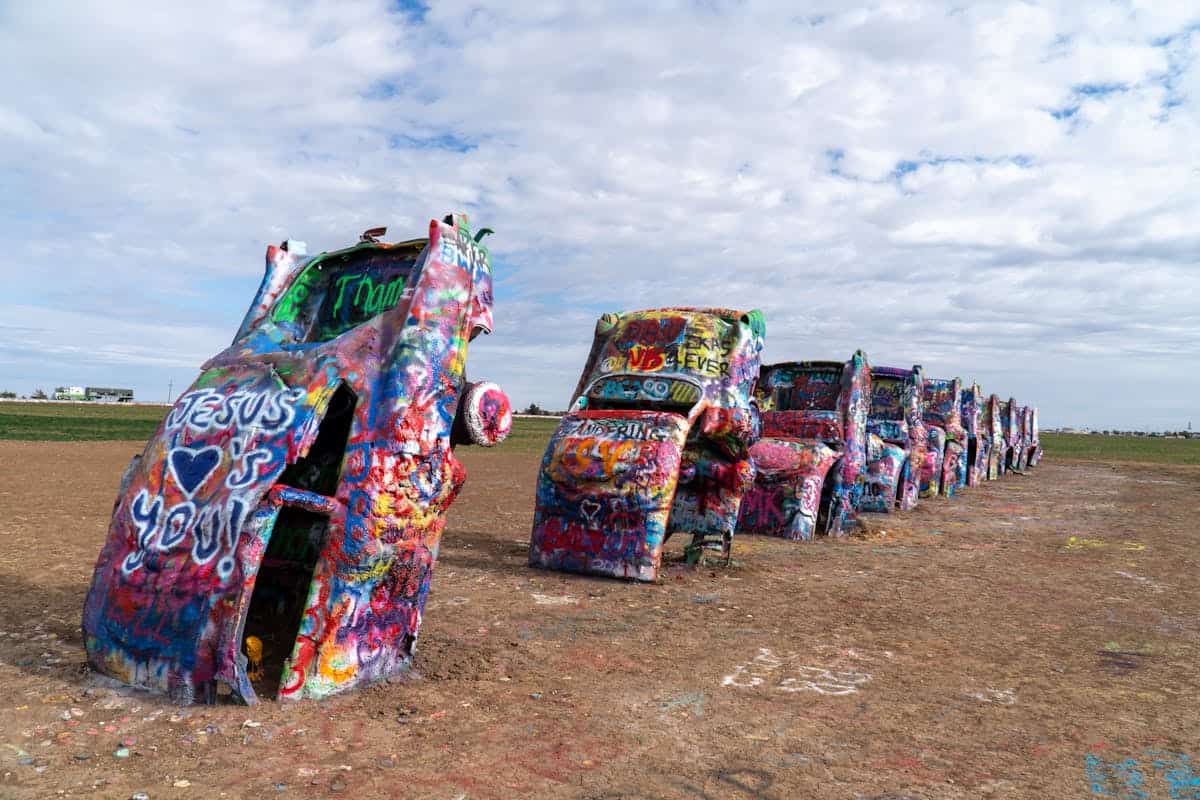
The famous Cadillac Ranch in Amarillo features ten Cadillacs buried nose-first in a field. While you’re here, try the famous 72-ounce steak challenge at the Big Texan Steak Ranch – and remember to swing by Shamrock, where the U-Drop Inn, built in 1936, served as inspiration for a building in Cars’ Radiator Springs.
New Mexico
The Blue Swallow Motel in Tucumcari is listed on the National Register of Historic Places – and the Route 66 Neon Drive-Thru Sign in Grants marks the Continental Divide! Albuquerque has invested in restoring historic neon signs along its portion of the route, so be sure to drive through at night for the full experience.
Arizona
Delgadillo’s Snow Cap Drive-In in Seligman has served burgers to Route 66 travelers since 1953, and the Wigwam Motel in Holbrook lets guests sleep in concrete teepees. And you can’t miss Oatman’s wild burros wandering Main Street!
California
Roy’s Motel and Café in Amboy features restored Googie architecture – excellent for a nostalgic Route 66 stop. Don’t forget to stop by Elmer’s Bottle Tree Ranch in Oro Grande, which displays sculptures made from glass bottles and vintage items. Finish your trip at the beautiful Santa Monica Pier.
Ready to Travel?
Route 66 is no longer an official highway, so you won’t find continuous route markers – here are a few quick tips for planning your road trip:
Many states have installed brown “Historic Route 66” signs, but a dedicated Route 66 map or GPS app helps fill in the gaps. Several apps and guidebooks provide turn-by-turn directions for following the original alignment.
Not all of Route 66 is drivable. Some sections have been paved over by Interstate 40, while others have deteriorated or been closed. A good guidebook can help you figure out which segments are accessible and which require Interstate detours.
There are lots of gas stations along the Interstate, but if you’re sticking to the historic route through small towns, keep your tank at least half full, as some remote stretches in the desert Southwest have limited services.
You can find all kinds of accommodations along the route, ranging from historic motels (some restored, others a bit more worn) to chain hotels and everything in between. And during the centennial, popular stops will book up quickly – so start planning early, and Happy Travels!
About the Author
Originally from Indiana, Heather believes every destination has a story worth telling and a reason to visit. With a deep love of adventure, history, and psychology, she shares travel trivia, tips, and inspiration to encourage you to explore the world with curiosity and optimism. Read her other articles on Frayed Passport here.Featured image by Ken Jacobsen on Pexels
FOLLOW US ON INSTAGRAM


Information published on this website and across our networks can change over time. Stories and recommendations reflect the subjective opinions of our writers. You should consult multiple sources to ensure you have the most current, safe, and correct details for your own research and plans.